Tuesday, May 08, 2018

Pocket Museum

In collaboration with the Hunt Museum in Limerick, the Masters students in Interactive Media in CSIS at UL created their own pocket museums. The exhibition was officially opened today, as Dr. Mikael Fernström delivered a highlights lecture in the museum on the topic of Pocket Museums.
You can download a PDF of the exhibition catalogue here.

Wednesday, December 07, 2016

Digital Tools for Museum Professionals: Limerick, Ireland, 19-20 January 2017

Two days workshop organised by the Interaction Design Centre at the University of Limerick, as part of the EU meSch project.


Are you a museum professional interested in emerging technologies for cultural heritage?
Are you a museum professional keen on reimagining how heritage can be revitalised using technology?
Would you like to experiment with designing and developing interactive exhibitions?


If so, join us in Limerick on 19th and 20th January 2017! During these two days, participants will have the chance to explore design concepts and bring them to life using the kit developed over the last four years by the meSch project.

Participants will select and adapt appropriate content to create new and exciting visitor experiences. This event will provide an opportunity for participants to learn about new digital tools, explore design thinking for creating innovative visitor experiences, and network with like-minded professionals. No prior technical or design experience is required!

Venue: Interaction Design Centre, University of Limerick, Ireland
Duration: Thursday 19 January 2017, 10:30am - Friday 20 January 2017 - 5pm

Places are limited. You have to commit to participate for the whole duration of the workshop.

If you are interested in participating, please fill out the application by 20 December 2016 at the latest. Acceptance will be communicated by January 11th, 2017.


About the meSch project
How can heritage be brought to life with digital content? The Material Encounters with digital Cultural Heritage (meSch) project (2013-2017) aims to enrich heritage artefacts by bringing objects, stories and materiality to the forefront of the experience. Its primary goal is to connect the physical experience of heritage to the digital in novel ways. The project has devised a toolkit to enable curators and other museum professionals to create new and exciting experiences enriched with digital content.

Four museums across Europe have explored meSch technology: in Amsterdam, the Allard Pierson Museum; in the Hague (Netherlands), Museon; in Rovereto (Italy), Museo Storico Italiano della Guerra; and in Limerick (Ireland), The Hunt Museum. For more information on these, follow these links:

http://mesch-project.eu/new-video-smart-object-enhanced-museum-exhibiton/
http://mesch-project.eu/apm-feint-video/
http://mesch-project.eu/voices-from-fort-pozzacchio/
http://mesch-project.eu/the-loupe-strikes-again-revealing-narratives-in-a-museum-in-ireland/

For further information on the meSch project, click here.

Sunday, June 19, 2016

Frontend IOM Boot camp

Two of our Imedia students - Conor Souness & Manasi Shetye - were selected to participate in the IOM boot camp run by Frontend. Here Manasi reports.

The IOM Boot camp was a three day intensive workshop organised by the User Experience Design agency, Frontend in Dublin from 13th of June to 15th of June 2016. The selection for this workshop was based on our portfolios which were submitted online before 30th of May 2016. I was exhilarated to be short-listed amongst the 10 candidates for this bootcamp from four Universities namely University of Limerick, IT Carlow, National College of Art and Design (NCAD) and Trinity College, Dublin.

IOM Boot Camp - Day 1

The first day at the boot camp was scheduled from 10am to 9pm. It started with an introductory session and IOM presentation by John Buckley, UX designer at Frontend. He briefly described the issues faced by the migrants entering the European Countries, their routes of migration, three ideal personas, contents of the health pack, to be designed and potential treatments for the illnesses. We had a video skype call with Teresa Zakaria, Doctor of Medicine, IOM. She clarified the specifications of the health pack for the migrants and the scenarios of distributing the packs to the constantly moving migrants.


It was followed by a talk with a migrant named Kamal from Istanbul, who visited us to discuss what is the situation of the migrants in Ireland currently, and suggested how the respective government could aid these migrants towards a better future. After a short break we split into groups of twos and enlisted the overall issues of the migrants one on each post-it. The groups then assembled all the post-its on the brain storming boards and the National Creative Directors, Frank Long and Henry Poskit directed the categorisation of the issues. John concluded with putting across four projects for the teams. The projects were as follows:
  1. Designing the Health Pack (Product Design)
  2. Information Design (Graphic Design)
  3. Distribution of the packs (Service Design)
  4. Digital presence and aid (Application Design corresponding the Service Design)


The candidates selected their own groups and started working towards potential solutions for the assigned projects. And of the day each and every group had a discussion over their individual thought process and concepts to come up with a cohesive design system.


IOM Boot Camp - Day 2


The second day kick started implementing the potential solutions digitally. I was working with Susana, and Adrian to graphically represent the information design for the set of instructions to use the health pack. We first sketched the layouts for the possible designs and tried incorporating the contents.


We also visited a Pharmacy to observe the designs of the medical packs and observed the hierarchy of the design. For instance the title of the medicine in big bold letters and the quantity and descriptors in less prominent type sizes. We also observed the graphic styles of the info graphics on the packs.


We had a discussion with Frank from Frontend and he guided us to create a mental model of the design which can be applied across various mediums like print, posters, application design and a digital platform as well. The mental model displayed the category of the medicine, whether it was a pill, or a liquid solution or a cream and we assigned a numbering system to all the contents in the pack along with a colour code for a better visibility in the pack and easy differentiation. Followed by the Dos and Don'ts related to the medicine. Then the pictographic representation of the usage of the medicine. The Mental model concluded with the support information of the IOM website and helpline in case of query and also a bar code in case IOM wants to track the movement of the migrants anonymously. We presented our solutions for our respective projects at the end of the day and got a fair feedback in terms of iterating the design.

Mental model of the Medicine’s information


 Iconography, Colour coding, Numbering System


IOM Boot Camp - Day 3


We iterated the designs after the Day 2’s feedback session. Design is certainly an evolving process and when we look back at we started and where we reached it was a satisfactory feeling of improvement. A simple though essential mental model and its improved graphic representation gave a promising look to the health packs. We also tried designing mockups for the graphical unit in order to see how the post production would come across for the pack design. We finally presented our designs and the entire process to the entire team of Frontend. We were definitely appreciated for all the work that was put within a span of three days through out the bootcamp.


Visual representation of the Mental Model


Visual representation of the Mental Model for pills


Visual representation of the Mental Model for a Syrup


I also learned a few things through the presentations by the other teams working on the Service design, health pack design and the corresponding application design. Since we discussed and presented individual ideas and concepts on the second day of the camp, all the projects came together to form a cohesive system of design for the health packs, information and distribution to the migrants on the go. I thoroughly relished the three days spent at the bootcamp. It gave me hands on experience working with professionals a project that will eventually be implemented for a good cause.

Thursday, September 10, 2015

The launch of the Alternative Perspective tours at The Hunt Museum

The Interaction Design Centre at the University of Limerick and The Hunt Museum are organising a public event to mark the inauguration of the “Alternative Perspectives” museum tours on Tuesday, 15 September 2015, 11am at the Hunt Museum.
The exhibition marks the launch of a self-guided tour using The Loupe, a smart artefact developed as part of the Material EncounterS with digital Cultural Heritage (meSch) EU project.
The aim of the meSch project is to design and develop a platform that will allow cultural heritage professionals to build  and modify their own interactive exhibits, and re-use existing multimedia digital content. It involves thirteen partners in six European countries and several cultural heritage institutions.
The already existing tours “History of Ireland in 10 objects” and "Architecture in the Hunt Museum" offered by the Hunt Museum to explore its eclectic collection (using a brochure or led by docent) are now offered in a new form – assisted by The Loupe.
The event,  which will take place in The Captain’s Room, will be opened by Hugh Maguire, director of the Hunt Museum. Dr Luigina Ciolfi  (Sheffield-Hallam University, UK, meSch coordinating partner) and Dr. Gabriela Avram (Interaction Design Centre, UL) will speak about the meSch project and respectively about the 2015- Year of Irish Design initiative, which funded the exhibition.
Laura Maye, the UL interaction designer behind the exhibition who has worked together with the team at The Hunt Museum (curators, docents and interns) will introduce the tour, after which the participants will be invited to experience the Loupe-assisted tour.

Thursday, April 16, 2015

Steampunk'd : exhibition of student works

This exhibition is based on course work byMasters and PhD students in the Department of Computer Science and Information Systems at the University of Limerick. Since 2010, in the course Contemporary Art in the Public Realm, students have worked in a dialogue with the Hunt Museum in Limerick City, using the Hunt Collection as inspiration for creating contemporary interpretations that can be juxtaposed with the original artefacts. This year’s theme is Steampunk, an art form (or cult) with its origins in literature as a subculture to genres such as fantasy and science fiction. Steampunk, in the physical form of various artefacts, often has an expectation that it relies on Victorian-style steam- or spring-powered technology. The materials used for creating the artefacts in this exhibition are mainly recycled. This year’s students had the opportunity to be coached into becoming creative makers by the eminent blacksmith and coppersmith Mark Wilson from Mountshannon, Co. Clare.
The exhibition is on display in the Bourn Vincent Gallery at the University of Limerick until the 23rd of April 2015. Admission is free.


Wednesday, April 30, 2014

Model and 3D print your very own museum-inspired creation!

In response to a very popular event on digital technologies and museums held at the Hunt Museum in January, the meSch team from the Interaction Design Centre at the University of Limerick are facilitating anotehr workshop relating to 3D printing in museums. Emerging 3D printing technologies are providing different possibilities for engaging and interacting with physical museum objects. Through a series of three workshops, participants will be provided an overview of 3D printing in museum contexts and will also build and print their very own 3D creation! No prior experience in 3D printing is necessary. This event was organised by the meSch team at the in response to a very successful event focusing on 3D Printing and Museums held at the Hunt Museum in Limerick.

Participants will also be given a tour of the Hunt Museum, which houses an internationally important personal collection featuring art and antiquities formed by John and Gertrude Hunt. The final printed creation will also be exhibited at this museum for a period of time!

These workshops have been organised by the meSch team at the Interaction Design Centre in collaboration with the Hunt Museum and will coincide with the Limerick City of Culture 2014.

Workshop dates and times:

June 5th 2:00pm - 5.30pm (Thursday)
June 19th 2:00pm - 5.30pm (Thursday)
July 10th 2:00pm - 5:30pm (Thursday)
Participants should be available on all three days.

Book now on EventBrite!
Eventbrite - 3D Printing and Museums

For more information on the event, contact laura.maye@ul.ie.


3D Printing in Museums event at the Hunt Museum, January 2014
Preliminary programme:
Day 1: June 5th 2014 (2:00pm – 5:30pm)
Tour of the Hunt Museum
Introduction to 3D printing and modelling

Day 2: June 19th (2:00pm – 5:30pm)
Practice digital modelling/printing

Day 3: July 10th (2:00pm – 5:30pm)
Demo of final models
Finalizing 3D Prints


Monday, May 20, 2013

Design@UL is progress

It's that happy time of the year when we're in the middle of assessing, marking and grading but since last year we also have a new and creative activity - Design@UL. This year, all the design-related groups and departments at UL are coming together to put up an exhibition of students' work in the former Franciscan church on Henry Street in Limerick City. The exhibition opens the 28th of May at 18:00 and runs until the 1st of June 17:00. With free admission and a city center location, we hope people from both near and far will come and enjoy the creativity.

Monday, April 15, 2013

TweekIrishHeritage: What Describes the Cultural Heritage of Ireland?

As part of a DMARC initiative included in the weeklong Limerick Lifelong Learning Festival, I (Laura Maye) hosted a Twitter experiment online for anyone in the world to take part in. The event took place on the 23rd March 2013 from 11am – 5pm GMT. The experiment was run from Faber Studios, Limerick, Ireland at the same time, and the studios were open to the public. The experiment took the form of a game entitled TweekIrishHeritage; in this game, participants were asked what they thought best described the cultural heritage of Ireland.

The goal of this research was to explore the involvement of onsite and remote audiences in the broadcast of a live event relating to cultural heritage that required minimum participant effort. In order to gather participants, the event was advertised on several Facebook pages, and a Facebook event was created to promote it.

On the game interface, there were three stick men and three destinations: a pub, a landmark and a museum. To partake in the game, participants had to tweet a keyword to move their chosen stick man to his destination: #irepubculture1 for pubs; #irelandmark2 for landmarks; and #iremuseum3 for museums. Once a stick man reached his destination, some information about a pub, landmark or museum appeared on screen and the game reset.


I built a very small prototype of a 6 x 1 LED matrix to provide visualisations of the votes. The green lights represented the votes for pubs, the red lights represented the votes for landmarks, and the amber lights represented the votes for museums. At the beginning of the game, pubs were winning by a long shot (see figure below)!


A total of thirteen people participated in the event; three of these people were onsite participants, and ten were online participants. Some participants posted more than one tweet and voted for more than one category.

At the end of the game, the results demonstrated that more people thought landmarks describe the cultural heritage of Ireland. Hey, I’m just as surprised as you are; however, there is nothing nicer than heading to Dun Aonghas on Inis Mór for a peaceful break or strolling around the blissful terrains near the Burren, Co. Clare.

Tuesday, April 02, 2013

Design Jam Limerick

This year’s Design Jam Limerick will be held on 17th April 2013 starting at 3pm at the Interaction Design Centre at the University of Limerick. This event promises to introduce some creative challenges to all participants. Everyone is invited to participate in the Design Jam! Attendees will be faced with a user experience challenge themed around Limerick’s cultural heritage. Laura Maye (PhD student working on the meSch project) and Alan Ryan (3rd year Digital Media Design) are the organisers of this year’s Design Jam Limerick.

Design Jams are non-profit, one-day design events where groups of people come together to engage in user experience challenges. Anyone can participate in a Design Jam. They are held in several locations internationally each year. Last year, Limerick hosted its first, very successful and fun Design Jam themed around turning Limerick into fab city. Design ideas explored on the day aimed to introduce concepts that would produce a more positive atmosphere in Limerick. The very first Design Jam in Ireland was organized by Daniel Beere and William Kennedy (at the time final year students in Digital Media Design) in April 2012. It was followed by Design Jam Dublin in September 2012, organized by the same Daniel Beere and William Kennedy, joined by Eamonn Finn (also a Digital Media Design alumnus).

This year’s Design Jam Limerick aims to bring together participants from different backgrounds to work together on a very relevant theme for Limerick, especially since it was designated Ireland’s first city of culture for 2014.

Design Jam Limerick will be themed around the cultural heritage of Limerick. Limerick is a very rich city from a cultural heritage perspective, and many of its hidden gems are very little known to the public. This year’s challenge will be to devise design ideas to promote and encourage the public to engage with Limerick’s cultural heritage.

Admission is free, but reserving a place at designjamlimerick13.eventbrite.ie is necessary. Sponsorship for the event will also be greatly appreciated. Contact laura.maye@ul.ie if you are able to contribute or send us a donation through the Eventbrite facility!

Many thanks to Dr. Gabriela Avram, who supported the initiative of hosting a Design Jam in Limerick since its inception in 2012!

Thursday, January 24, 2013

Research assistant position for new EU project

We're happy to announce a job opening for a research assistant in participatory interaction design at the Interaction Design Centre.

The researcher will work on a new EU collaborative project, 'meSch', bringing together 12 partners working on the creation of novel tangible experiences for heritage sites.

More information about the project is available on the IDC website.

Applications will have to be submitted through the University of Limerick recruitment website.

The application deadline is 25 February 2013, 12PM.

Music by Pong - Masters Students discuss their projects


In the video shown below, three Masters students studying Interactive Media discussed their final project for module CS6221 (Programming Protocols for Musical Systems). The project involved developing a game of Pong in Processing to control the generation of sound in Max/MSP and Logic. After weeks of challenging yet rewarding work, students presented their project in the postgraduate studio at the University of Limerick. The video was produced by Laura Maye, but all credit for editing this video goes to Rianne Links, Laurie Skelton and Dominic Perera, well done to you all!

Wednesday, January 23, 2013

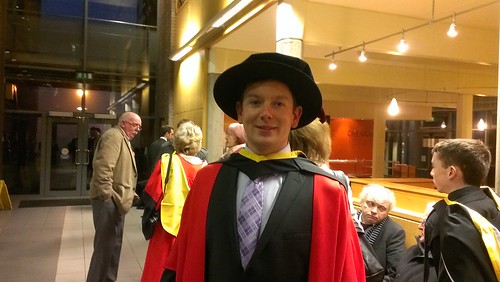
Congratulations to Dr. Paul Gallagher!

Yesterday, during the Winter Conferring ceremony, Paul Gallagher was awarded his PhD title.
Paul was presented with his doctoral cap by his supervisor, Prof. Liam Bannon, and received his doctoral degree from the President of the university, Prof. Don Barry.


Congratulations to Paul and all the best in his future career !

Thursday, December 27, 2012

Four fairytale short-films

This year's Masters students in Interactive Media were given four fairytale stories by Stephen Ross (thanks!). After a few weeks hard work, learning the craft of video-making, the students presented their short-films in Dr.John's Bar in Limerick City, where they also put up a photographic exhibition. The place was packed with people on the night and a collection was made in aid of the Irish Cancer Society.

Here are the four films:

The shoemaker


The Shoemaker from studentiMedia on Vimeo.

The library of shadows


The Library of Shadows from UL iMedia 2012/2013 on Vimeo.

The last songbird


Short film: The Last Songbird from Rianne Links on Vimeo.

The sailor who drank the sea


The Sailor Who Drank The Sea from The_Sailor_Who_Drank_The_Sea on Vimeo.


Wednesday, October 17, 2012

First 7 Weeks app


The University of Limerick’s First 7 Weeks orientation programme has this year launched a new Android app and mobile website for first year students. The app and website were created by Daryl Feehely who is a research MSc student in the IDC.

Both the app and website deliver all the information about each week of the First Seven Weeks programme to students. The Android app has the additional feature of indoor maps, which provide users with floor maps of the undergraduate buildings on campus, which they can use to navigate their way inside each building. QR codes are placed in each building also, allowing the user to view their position and plot a route on the indoor map by scanning a QR code with the app.

The app and website were developed as part of a collaborative research project between the Centre for Teaching & Learning and the IDC. The research being carried out by Daryl is in the area of information delivery using mobile technology, and focuses in particular on the analysis of lightweight, self-contained, low-fidelity indoor mapping solutions. The deployment of the First 7 Weeks app will be used to gather anonymous data on how users interact with 2D indoor map interfaces, in the context of imprecision when the maps are being used to guide a user to a location rather than pinpoint a location to a user.

"This new application for first years has a dual purpose providing a service to newcomers to the campus as well as giving us the opportunity to analyse the most effective ways to deliver information using mobile devices and especially testing to see if a low-fidelity indoor map delivers sufficient information to direct a user to their destination. The First 7 Weeks programme is a natural partner to test this research with, given its goal to deliver information to first year students and help them get acquainted with the UL campus. We developed the First Seven Weeks Android app and mobile website to that end, in the hope of making the transition from school to college easier for incoming UL students, by giving them easy access to the information and campus maps on their smartphones. In conjunction with the Buildings & Estates Department we've placed QR codes around the buildings on campus. Users of the Android app can scan these QR codes with the app to view their location on a map, which will help them get to where they are going,” said Daryl Feehely

The Android App is available to download on the Google Play store, and all the First 7 Weeks information is also available on the mobile website http://first7weeks.ul.ie

More information on how to use the Android app can be view in this demo video:


Monday, July 30, 2012

Success for "Magic Is Might 2012"

An international conference on the cultural influence of the Harry Potter books and films, "Magic Is Might 2012", was held at the University of Limerick last week. IDC's Luigina Ciolfi was one of the co-organisers together with Gráinne O'Brien of the Department of Sociology. The conference saw 20 presentations by academics from 10 countries on various aspects of how the story of the boy wizard has led to different analyses and reflections, from how it has inspired technology design and transmedia storytelling, to education, gender studies and literary theory.
The keynote presentation was delivered by Abbot Mark Patrick Hederman of Glenstal Abbey on the theme "Harry Potter: Archetype of the Child as our Future in the 21st Century". Coverage of the event can also be found online on The Irish Times, The Irish Independent, The Examiner, The Limerick Leader, and RTE News.

Friday, June 15, 2012

A very interesting exhibition opening this afternoon in the Hunt Museum, with works from our Masters students in Interactive Media and in Music Technology.


Tuesday, May 29, 2012

DESIGN@UL Exhibition - Franciscan Church, Henry Street, Limerick


The entrance of the exhibition...


The beautiful space is packed with design material of all sort...


The Digital and Interactive design area a.k.a. 'The Silicon Alley' (with a not so digital and interactive sign...:)...)


BIT - The Interactive Bin (click here)


The Digital Hiker (in a confessional...)

Tuesday, March 27, 2012

"Magic is Might 2012" Programme & Registration Available!

Magic is Might 2012: An International Academic Conference Exploring the Cultural Influences of the Harry Potter Books and Films

Hosted by the University of Limerick Department of Sociology and by the UL Interaction Design Centre.

University of Limerick, Ireland

July 23-24 2012

Full Program now available

Registration now open!

The Harry Potter series has become a publishing phenomenon that has captured the imagination of children and adults all over the world. The stories created by J.K. Rowling have inspired extensive multidisciplinary academic discussion, ranging from cultural and literary analyses, sociological and philosophical interpretations, design practices, to recognised medical publications. Conferences have taken place that focused on the impact that the novels have had on the world and their educational contribution and edited collections have been produced centering on themes of philosophy, religion, sociology, and critical analysis, to name just a few. The characters' relationships, the political and social systems, and cultural commentaries woven into Rowling’s writing are just some examples of what makes the Harry Potter series an exciting framework for academic discourse in a number of areas. This two-day event will feature twenty 15-20 minute presentations on papers relating to popular culture and the Harry Potter series. We will encourage intensive and lively discussion and debate around the papers over the two days in this intimate setting. The conference will feature opening remarks by Dr. Eoin Devereux, author of "Understanding the Media", Head of the UL Dept. of Sociology and a world-renowned expert on fandom, and a keynote presentation by Dom Mark Patrick Hederman, OSB, Abbott of Glenstal Abbey, lecturer and writer, on "Harry Potter" Archetype of the Child as our future in the 21st Century".

Wizards, Muggles, established academics and postgraduate students are invited to join the conference!

Conference organisers:

Gráinne O’Brien (University of Limerick, Ireland) Dr. Luigina Ciolfi (University of Limerick, Ireland) Jadwiga O’Brien (National University of Galway, Ireland) Lette Moloney (MoloneyMedia and Interaction Design Centre, UL)

Our Facebook page

To Register: http://magicismight2012.eventbrite.com/?ebtv=C

Follow us on twitter @magicismight12

This conference is NOT authorized by J.K. Rowling, her US or UK publishers, WB, Universal Studios or any other official Harry Potter related or trademarked entity.

Friday, February 17, 2012

Faculty of Science and Engineering Scholarship

This year, two of the students currently enrolled in the Master program in Interactive Media have been awarded the Faculty of Science and Engineering Scholarship. The awarding ceremony took place in the Millstream Common Room on the 26th of January.

Congratulation to Xiaonan Gao and Yefan Wang.

Xiaonan Gao (left) and Yefan Wang (right) receive the award from Prof. Paul McCutcheon - Vice President Academic & Registrar
Xiaonan Gao and Yefan Wang with course leader Dr. Cristiano Storni