Tuesday, October 19, 2010
Congrats to Softday on "Marbh Chrios"
Congrats to Mikael Fernstrom and Softday on the recent successful performance of "Marbh Chrios", which took place on October 16th at Mooney's Boatyard in Killybegs, Co. Donegal. Congrats to Mikael and Sean on their success!

Success for the third Edition of Tweak Festival
Between September 17th and 24th 2010, Limerick was yet again buzzing thanks to Tweak, the interactive digital art festival featuring an exhibition, workshops, concerts and a cinema day. Tweak is aiming to promote the understanding of the use of technology in our lives and has been curated by IDC Nora O'Murchu in collaboration with (among others) UL IDC, the Limerick School of Art and Design, the arts Council and Creative Limerick
Wednesday, August 18, 2010
"Reminisce" at Bunratty Folk Park going Live!
“Reminisce” at Bunratty Folk Park
August 25-27 2010
Are you curious about how interactive technology can bring memories of the past to life? Then try out "Reminisce" at Bunratty Folk Park!
Researchers at the Interaction Design Centre have developed a new interactive experience, "Reminisce", which will allow visitors of Bunratty Folk Park in Co. Clare to discover, share and contribute to personal memories linked to buildings, traditions and ways of life of Ireland's past. "Reminisce" will engage visitors in a quest for memories and mementoes to add value to their experience of the cottages and activities on display at the Park.
The IDC is a multidisciplinary research group in the Dept. of Computer Science and Information Systems at the University of Limerick, focused on the design, use and evaluation of information and communications technologies from a human-centred design perspective: our research is focused on enhancing and supporting people's activities and is grounded on the context of the users' experience. The IDC has conducted extensive research on the use of ICTs in museums and exhibitions during the past 10 years, with successful installations at The Hunt Museum, Shannon Airport and Limerick’s Milk Market.
"Reminisce" is part of a research project exploring the utility and potential of technologies such as smart phones, augmented reality and location-based services in outdoor exhibition sites, and it has been supported by Failte Ireland and the University of Limerick Seed Funding initiative.
"Reminisce" is easy to use, doesn't require any specialised equipment and is completely free. It will be available for trials at Bunratty Folk Park from the 25th to the 27th of August 2010.
If you would like to try out "Reminisce", please contact luigina.ciolfi@ul.ie or marc.mcloughlin@ul.ie, or get in touch through our Facebook page or Twitter
August 25-27 2010
Are you curious about how interactive technology can bring memories of the past to life? Then try out "Reminisce" at Bunratty Folk Park!
Researchers at the Interaction Design Centre have developed a new interactive experience, "Reminisce", which will allow visitors of Bunratty Folk Park in Co. Clare to discover, share and contribute to personal memories linked to buildings, traditions and ways of life of Ireland's past. "Reminisce" will engage visitors in a quest for memories and mementoes to add value to their experience of the cottages and activities on display at the Park.
The IDC is a multidisciplinary research group in the Dept. of Computer Science and Information Systems at the University of Limerick, focused on the design, use and evaluation of information and communications technologies from a human-centred design perspective: our research is focused on enhancing and supporting people's activities and is grounded on the context of the users' experience. The IDC has conducted extensive research on the use of ICTs in museums and exhibitions during the past 10 years, with successful installations at The Hunt Museum, Shannon Airport and Limerick’s Milk Market.
"Reminisce" is part of a research project exploring the utility and potential of technologies such as smart phones, augmented reality and location-based services in outdoor exhibition sites, and it has been supported by Failte Ireland and the University of Limerick Seed Funding initiative.
"Reminisce" is easy to use, doesn't require any specialised equipment and is completely free. It will be available for trials at Bunratty Folk Park from the 25th to the 27th of August 2010.
If you would like to try out "Reminisce", please contact luigina.ciolfi@ul.ie or marc.mcloughlin@ul.ie, or get in touch through our Facebook page or Twitter
Thursday, April 29, 2010
Congratulations to Dr Erik and Dr Anders!
This week, Anders Sigfridsson and Erik Lövquist successfully completed their PhD vivas.
 Dr. Annette Aboulafia (Erik's supervisor), Erik Lövquist, Prof Liam Bannon (Anders' supervisor) and Anders Sigfridson.

Tuesday, March 02, 2010
Interaction Design Talks: Fernando Orellana
The Interaction Design Talks series continues this semester with a talk by Fernando Orellana.
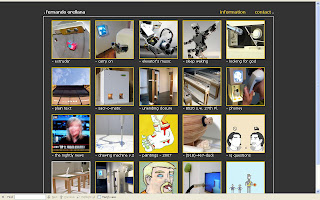
Fernando will speak about his recent artwork relating to robotics, anthropomorphism, dreams, generative art, automobiles, and Play-doh.
He was one of the artists featured during the 2nd edition of Tweak in September last year.
Currently an Assistant Professor developing an electronic art program at Union College in Schenectady, NY, Fernando Orellana uses new and traditional media as a way of transmitting concepts that range from generative art to social-political commentary. He has recently exhibited at the Carrie Haddad Gallery, Hudson, NY, Espacio Fundación Telefónica, Buenos Aires, Argentina, The Mandeville Gallery, Schenectady, NY, Exit Art, New York, New York, LABoral, Gijon, Spain, The Tang Museum of Art, Saratoga Springs, NY, Glass Curtain Gallery, Chicago, IL, The Ark, Dublin, Ireland, and The Biennial of Electronic Art, Perth, Australia.
The talk will take place this Wednesday, 3 March 2010, 2:30pm in KBG13 (Kemmy Business School), and everybody is welcome!
Monday, February 01, 2010
Interaction Design Talks: Nicholas Polley
Wednesday, 3 February 2010, the Interaction Design Talks series continues with a talk by Nicholas Polley, the founder of the Dublin-based company 3rd Dimension.
The talk, titled Inside 3D Visualisation, is scheduled for 2:30pm in KB119, and everybody is welcome.
3rd Dimension's Visualisation and Animation studios are based in Blackrock in Co Dublin. The company is focused on creating design solutions that include 3D visuals, photomontages, visual impact assessments and 3D walkthroughs meant to support their clients planning and marketing strategies.
Nicholas will speak about his company's past and ongoing projects, referring to the processes and technologies involved. He will also focus on the advances in 3D visualisation technologies over the years and the vital role played by these in many industries (Architecture, Engineering, Design, Games Development).

On Wednesday evening, Nicholas Polley will also give a talk at the IxDA Limerick meetup in the Absolute Hotel. The meetup starts at 7pm as usual. All are welcome!
The talk, titled Inside 3D Visualisation, is scheduled for 2:30pm in KB119, and everybody is welcome.
3rd Dimension's Visualisation and Animation studios are based in Blackrock in Co Dublin. The company is focused on creating design solutions that include 3D visuals, photomontages, visual impact assessments and 3D walkthroughs meant to support their clients planning and marketing strategies.
Nicholas will speak about his company's past and ongoing projects, referring to the processes and technologies involved. He will also focus on the advances in 3D visualisation technologies over the years and the vital role played by these in many industries (Architecture, Engineering, Design, Games Development).

On Wednesday evening, Nicholas Polley will also give a talk at the IxDA Limerick meetup in the Absolute Hotel. The meetup starts at 7pm as usual. All are welcome!
Thursday, December 17, 2009
Reassembling Health: exploring the role of the internet of things

Last Friday, the 4th of December Cristiano Storni led a workshop at LIFT@Home under the event 'Are you ready for the Internet of Things' where the Think tank 'The Council' launched.
Workshop description can be found here;
Workshop report can be found here (draft);
Some of the Workshop material can be found here (presentation), here (concept map), and here (inspirational booklet);

The Council website can be found here;
The LIFT event link can be found here.
Tuesday, November 24, 2009
'Problematizing Design' Panel with Cristiano Storni and Aphra Kerr
Cristiano Storni has participated to the Workshop 'Ethnography, Creativity and design' as part of the Anthropology seminar series in collaboration with Intel last November the 12th at NUI Maynooth. Cristiano Storni was part of the panel 'Problematizing design' with Lecturer Aphra Kerr. In his presentation (The politics of design inthe Health Care dispositif), Cristiano has shared some of the finds of his research on self-care practices and technology. He argued for the limit of the medical model in self and home care practices and the need to create room for more dialogical collaborations between lay persons and expert practitioners in care. Aphra Kerr has presented her research on the game industry by problematize the relationship between producers and users in the digital game domain. Intel hosted part of the seminar and provide a series of presentations regarding the Independent Living project and the related Tril centre (www.trilcentre.org).
Program available here
Event brochure available here
Program available here
Event brochure available here
Tuesday, November 17, 2009
Interaction Design Talk: Macdara Butler
Wednesday, 18 Nov 2009, at 2:30 pm, Macdara Butler from Tricycle Interactive, will give a talk titled "Designers & Programmers - Crossing the Divide in Interactive Media Development" in room CSG001.
Designers & Programmers - Crossing the Divide in Interactive Media Development
Update (19 Nov 2009): Photos from Macdara's talk


Macdara Butler, the MD of Tricycle Interactive Ltd., has graduated from UL in 2003 with a Business degree in Economics, Finance & French. He worked in the financial sector for 2 years before returning to UL for the Interactive Media Masters. In October 2006, he set up Tricycle Interactive, together with 2 fellow graduates. Tricycle Interactive provides web applications, mobile software and interface design services.
Designers & Programmers - Crossing the Divide in Interactive Media Development
It is essential that design-oriented people increase their technical skills and knowledge in order to meet the demands of industry. Equally, programmers need to embrace the principles of User Centred Design and engage whole-heartedly with the designers to achieve successful outcomes.
When designers and programmers are able to communicate effectively, work closely together, and understand each other's domains, the team will achieve great results.
Update (19 Nov 2009): Photos from Macdara's talk


Saturday, November 14, 2009
IDC Team delivers "Get Connected" on behalf of the Irish Museums Association
On Friday, 13th of November, Gabriela Avram, Luigina Ciolfi, Eamonn Finn, Olivia Kennedy an Marc McLoughlin from IDC delivered a training day on behalf of the Irish Museums Association: "Get Connected. Your Museum and Web 2.0". Participants representing museums and other exhibition spaces and cultural institutions from all over Ireland were briefed on the benefits of using Web 2.0 tools to promote and support current activities at their institution. The workshop was hosted by The Hunt Museum
Monday, October 26, 2009
Interaction Design Talks: Nicola Quinn

The talk will take place in CSG001 and everybody is welcome!
Nicola Quinn is the Customer Experience Manager for RBS's flagship insurance brands - Churchill Insurance, Direct Line and Privilege. Her current role champions the interest of customers across the business, having a major impact on usability, and customer interaction. Previously she has worked as an Information Architect, User Experience Designer, Interaction Designer and Usability Consultant. Past clients have included Nokia, Lynx, Cornetto, Cancer Research UK, BBC, and Logitech. She has also spent time as a researcher at the Interaction Design Centre, Limerick. She recently co-authored a chapter for The Handbook of Computational Arts and Creative Informatics. She is a professional member of the Usability Professional Association, London Information Architects, and ACM Special Interest Group in Computer Graphics.
In her talk, Nicola will refer to how she got her UX/IA roles, where to begin, what to expect, types of roles, and in general to her experience of looking for and finding an interesting job in London.
(Photo: Nicola presenting the Phantom to visitors at the IDC Open Day back in June 2005)
Wednesday, August 12, 2009
Liam Bannon to deliver keynote at INTERACT 2009
The Director of the IDC, Prof. Liam Bannon will be one of the invited keynote speakers at INTERACT 2009, the IFIP conference on Human-Computer Interaction, to be held in Uppsala (Sweden) at the end of August. Liam will deliver the conference's closing keynote presentation on August 28th.
New IDC Website is launched
The new IDC website is finally live! After over a year of design, development and implementation, the IDC has a new showcase for current research, teaching and publication activities! Thanks to Nora, Anders, Conor, Colm, Gabriela, Paul and everyone else who has helped with the many tasks surrounding the creation of the website.
Thursday, June 18, 2009
Wednesday, May 20, 2009
Successful NWL Seminar
The Nomadic Work/Life Project (jointly run by IDC and the Dept. of Sociology and supported by ISKS - The Institute for the Study of Knowledge in Society at UL) hosted a successful international Seminar this week on the topic of "Mobility and Nomadicity:
Methodological Challenges and Innovations". Mobility is a key feature of globalization, interrelated with emerging technologies, socialities and labour forms. Although a wealth of studies have been addressing this reality, little has been said about the methodological dimension of mobilities research. By bringing together an international group of scholars, the goal of this seminar was to identify some of the main methodological innovations and challenges in the field of mobilities research. The seminar proceedings will be published as a special journal issue. Invited speakers were: Justin Spinney (Uinversity of Surrey), Elaine Moriarty (Trinity College Dublin), Michaela Benson (Keele University), Jo Vergunst (University of Aberdeen) and Misha Myers (University College Falmouth).
Methodological Challenges and Innovations". Mobility is a key feature of globalization, interrelated with emerging technologies, socialities and labour forms. Although a wealth of studies have been addressing this reality, little has been said about the methodological dimension of mobilities research. By bringing together an international group of scholars, the goal of this seminar was to identify some of the main methodological innovations and challenges in the field of mobilities research. The seminar proceedings will be published as a special journal issue. Invited speakers were: Justin Spinney (Uinversity of Surrey), Elaine Moriarty (Trinity College Dublin), Michaela Benson (Keele University), Jo Vergunst (University of Aberdeen) and Misha Myers (University College Falmouth).
IDC seminar series: Brian Coates on Deconstruction
 Brian Coates has given a talk within the IDC workshop series on the notion of Deconstruction on the 5th of May. Brian has offered a wide overview of the notion by largely drawing on the work by Derrida, Lacan, Foucault and Kristeva and some of their followers. According to Derrida, Deconstruction is '…is neither a philosophy, nor a doctrine, nor a knowledge, nor a method, nor a discipline, not even a determinate concept, only what happens if it happens –'. A quotation by Barbara Johnson has further framed the notion of deconstruction within the practice of 'teasing out of warring forces of signification within (any given) the text itself'.
"The de-construction of a text does not proceed by random doubt or arbitrary subversion, but by the careful teasing out of warring forces of signification within the text itself. If anything is destroyed in a deconstructive reading, it is not the text, but the claim to unequivocal domination of one mode of signifying over another".
Instances of decostruction and of warring forces have been provided through very interesting text analysis of Derrida’s dialogues with Plato, Rousseau, Husserl and Levi-Strauss; an analysis of the binary systems in Western culture and the need to deconstruct it was also presented; poems by Yeats, Eliot and Pound evidenced the crisis of modernity; Nietszche and Barthes were quoted to point up the way in which deconstruction works. Lacan’s concept of the mirror stage, Kristeva’s chora and Foucault’s panopticon provided examples of deconstruction at work. The group worked together on a practical exercise – to deconstruct a passage from J.M. Synge’s Journey to the Western Isles and a poem by Tom Leonard, ‘Yon Night’.
A debate has followed where IDCers has tried to make connection with their experiences and interests. Mikael Fernstrom showed how the very principles of deconstruction often guide his artistic practice especially when this is driven by hijacking intended design and tinkering with possibilities (he provided the link www.softday.ie). Cristiano Storni has tried to show the warring forces related with his actual domain of investigation (Health Care) by discussing (and possibly deconstructing) the notion of Compliance. Compliance is in fact a concept developed from the point of view of the doctor and of biomedicine and it has the specific function of showing what people should do and of rendering non-compliant behavior as a form of deviation in need of an explanation and of control. His point was to show that - for instance - when designing for patient empowerment certain notion can be misleading and bring not so much to an emancipation of patient but rather to further and even more subtle forms of dependencies.
Luigina Ciolfi has found interesting connections with Philosophy of science and asked about the relationship between the work of Derrida and the critical studies of science and scientific knowledge (e.g. as in Feyerabend). Further connection where found in the work of semioticians Kristeva.
Attempt to link the notion of deconstruction with the practice of design has been sketched and we are looking forward to follow up on this matter. Just as a hint, Brian told that the notion of deconstruction has found space within certain movements in architecture such as in the work of Gehry.
Slides are available for whom might be interested. The seminar has been also recorded.

Thursday, May 14, 2009
"Bridging Interaction Clouds" at ECSCW 2009
**********************CALL FOR PAPERS**********************
Workshop "Bridging “Interaction Clouds”: Exploring collaborative interaction across assemblies of mobile and embedded technology"
To be held at ECSCW 2009, Vienna, Austria 7-8 September.
http://bridgingclouds.blogspot.com
ECSCW09
***************************************************************
Overview
Portable technology, particularly in the shape of mobile phones and personal digital assistants, has become a ubiquitous force in everyday life. Advances in communication technologies have also meant that we are rapidly moving towards the convergence of mobile and stationary systems: this has allowed people to use mobile technology to engage with systems embedded in the environments they inhabit, offering a greater range of interaction possibilities and patterns that we have labeled “Interaction Clouds”. By “Interaction Clouds” we mean the complex patterns of interaction, sharing and exchange that unfold around assemblies of mobile and embedded technologies.
This workshop aims at exploring such issues in greater detail, with a specific focus on the design of a coherent social and collaborative experience for people as the transverse an “assembly” of technologies. The notion of Interaction Clouds also resonates with the emergence of the internet as a resource free of device and location constraints has brought about the concept of “cloud computing”, where technology is emerging that allows people to shift between multiple contexts (mobile/embedded), facilitated by a connection to remote computing resources (clouds). This devolving of traditional interaction paradigms brings with it new challenges to support meaningful user social and collaborative experiences, specifically how such hybrid systems can facilitate salient aspects of user experiences such as collaboration and participation.
Topics of Interest
• Studies of social and collaborative activity around interaction clouds
• Design for the support of collaboration and participation across interaction clouds
• New interaction modalities in interaction clouds that support social interaction
• Theoretical issues of how to define and study interaction clouds (merging mobility-oriented and space-oriented frameworks, new conceptual approaches, development of existing frameworks, etc.)
• Explorations of settings where interaction clouds can be meaningfully deployed: e.g. public spaces (museums, urbans areas), workplaces, domestic spaces, etc.
Dates and Deadlines
Submissions are due: June 20th, 2009
Notification of Authors: 6th July, 2009
Workshop at ECSCW 2009: September 7th - 8th, 2009
Submissions
Interested participants are invited to submit position papers in PDF format with a word limit of 5000 words. Papers should be formatted according to the ECSCW template see the instructions for authors.
The .pdf files should be sent to: marc.mcloughlin@ul.ie
Workshop outline
The Workshop will run over 1 day. The Workshop call requests the submission of short position papers. However, during the workshop, we will foster debate moving away from traditional presentations, and by facilitating discussions on shared artifacts. We will invite the participants to contribute to the workshop with either posters, or demos/prototypes, or video data documenting an experience, and these materials will be the main subject of the discussion. In the afternoon session, we will lead more focused small-group discussions and brainstorming, and practical design exercises.
Publication & dissemination
Accepted papers will be included in the Workshop Webpage. During the workshop participants will be asked to prepare posters for display during the conference. During the workshop, opportunties for future publications (such as a journal special issue) will be discussed.
Organizers
Marc McLoughlin, Interaction Design Centre, University of Limerick, Ireland
Luigina Ciolfi, Interaction Design Centre, University of Limerick, Ireland
Mike Fraser, University of Bristol, UK
Eva Hornecker, University of Strathclyde, UK
John Bowers, Interaction Research Studio, Goldsmiths, University of London, UK
Contact Details
Workshop Webpage: www.bridgingclouds.blogspot.com
Please Contact the workshop chairs at: marc.mcloughlin@ul.ie
Workshop "Bridging “Interaction Clouds”: Exploring collaborative interaction across assemblies of mobile and embedded technology"
To be held at ECSCW 2009, Vienna, Austria 7-8 September.
http://bridgingclouds.blogspot.com
ECSCW09
***************************************************************
Overview
Portable technology, particularly in the shape of mobile phones and personal digital assistants, has become a ubiquitous force in everyday life. Advances in communication technologies have also meant that we are rapidly moving towards the convergence of mobile and stationary systems: this has allowed people to use mobile technology to engage with systems embedded in the environments they inhabit, offering a greater range of interaction possibilities and patterns that we have labeled “Interaction Clouds”. By “Interaction Clouds” we mean the complex patterns of interaction, sharing and exchange that unfold around assemblies of mobile and embedded technologies.
This workshop aims at exploring such issues in greater detail, with a specific focus on the design of a coherent social and collaborative experience for people as the transverse an “assembly” of technologies. The notion of Interaction Clouds also resonates with the emergence of the internet as a resource free of device and location constraints has brought about the concept of “cloud computing”, where technology is emerging that allows people to shift between multiple contexts (mobile/embedded), facilitated by a connection to remote computing resources (clouds). This devolving of traditional interaction paradigms brings with it new challenges to support meaningful user social and collaborative experiences, specifically how such hybrid systems can facilitate salient aspects of user experiences such as collaboration and participation.
Topics of Interest
• Studies of social and collaborative activity around interaction clouds
• Design for the support of collaboration and participation across interaction clouds
• New interaction modalities in interaction clouds that support social interaction
• Theoretical issues of how to define and study interaction clouds (merging mobility-oriented and space-oriented frameworks, new conceptual approaches, development of existing frameworks, etc.)
• Explorations of settings where interaction clouds can be meaningfully deployed: e.g. public spaces (museums, urbans areas), workplaces, domestic spaces, etc.
Dates and Deadlines
Submissions are due: June 20th, 2009
Notification of Authors: 6th July, 2009
Workshop at ECSCW 2009: September 7th - 8th, 2009
Submissions
Interested participants are invited to submit position papers in PDF format with a word limit of 5000 words. Papers should be formatted according to the ECSCW template see the instructions for authors.
The .pdf files should be sent to: marc.mcloughlin@ul.ie
Workshop outline
The Workshop will run over 1 day. The Workshop call requests the submission of short position papers. However, during the workshop, we will foster debate moving away from traditional presentations, and by facilitating discussions on shared artifacts. We will invite the participants to contribute to the workshop with either posters, or demos/prototypes, or video data documenting an experience, and these materials will be the main subject of the discussion. In the afternoon session, we will lead more focused small-group discussions and brainstorming, and practical design exercises.
Publication & dissemination
Accepted papers will be included in the Workshop Webpage. During the workshop participants will be asked to prepare posters for display during the conference. During the workshop, opportunties for future publications (such as a journal special issue) will be discussed.
Organizers
Marc McLoughlin, Interaction Design Centre, University of Limerick, Ireland
Luigina Ciolfi, Interaction Design Centre, University of Limerick, Ireland
Mike Fraser, University of Bristol, UK
Eva Hornecker, University of Strathclyde, UK
John Bowers, Interaction Research Studio, Goldsmiths, University of London, UK
Contact Details
Workshop Webpage: www.bridgingclouds.blogspot.com
Please Contact the workshop chairs at: marc.mcloughlin@ul.ie
Saturday, April 18, 2009
Softday at INFECTIOUS in the Science Gallery
Softday (a.k.a. Mikael Fernström of IDC and Sean Taylor of LSAD) is showing their work Nobody Leaves Until the Daphnia Sing in the Science Gallery at TCD in Dublin.

The project was developed in collaboration with the National Water Toxicity Laboratory in Shannon, Co. Clare.
We built the prototype in the IDC laboratory at UL and finally installed the full works in the Science Gallery in Dublin.
The exhibit has four stations (bass, tenor, alto, soprano) each with a Petri-dish with Daphnia Magna whose movements are detected by a web-cam and converted into visuals and sound with a custom-designed PD/GEM-patch.
Saturday the 18th of April 2009, the Daphnia will sing together with a human ensemble of musicians recruited from the 3rd year students in Music, Media and Performance Technology in CSIS at UL.
The exhibition runs until the 17th of July 2009.
Also, thanks to Apple for some really great support

The project was developed in collaboration with the National Water Toxicity Laboratory in Shannon, Co. Clare.
We built the prototype in the IDC laboratory at UL and finally installed the full works in the Science Gallery in Dublin.
The exhibit has four stations (bass, tenor, alto, soprano) each with a Petri-dish with Daphnia Magna whose movements are detected by a web-cam and converted into visuals and sound with a custom-designed PD/GEM-patch.
Saturday the 18th of April 2009, the Daphnia will sing together with a human ensemble of musicians recruited from the 3rd year students in Music, Media and Performance Technology in CSIS at UL.
The exhibition runs until the 17th of July 2009.
Also, thanks to Apple for some really great support
Sunday, March 22, 2009
IDC Showcase at Irish Museums Association Conference 2009
The 2009 Conference of the Irish Museums Association was held at the City Hotel in Derry (Northern Ireland)from the 27th of February to the 1st of March. The theme of the conference was "The Museum: a Dialogue in Shared Histories and Common Heritage". Thanks to the support of IMA Chair Dr. Marie Bourke, IDC projects on the theme of museums and public exhibitions were showcased during the Conference to a number of delegates.

Lui and Liam jointly delivered a talk "The potential of new technology to encourage visitors to interact with the history and heritage of museum collections", while Marc looked after the exhibition area where demos and archive material documenting a number of IDC projects were displayed.

Highlights of the conference included keynote presentations by Professor Nigel Roulfe (Royal College of Art, London), Fintan O'Toole and Dr. Elaine Heumann Gurian.

Lui and Liam jointly delivered a talk "The potential of new technology to encourage visitors to interact with the history and heritage of museum collections", while Marc looked after the exhibition area where demos and archive material documenting a number of IDC projects were displayed.
Highlights of the conference included keynote presentations by Professor Nigel Roulfe (Royal College of Art, London), Fintan O'Toole and Dr. Elaine Heumann Gurian.
Wednesday, February 25, 2009
Subscribe to:
Posts (Atom)