Friday, October 27, 2006

Monday, October 09, 2006
Daniela Petrelli visiting the IDC
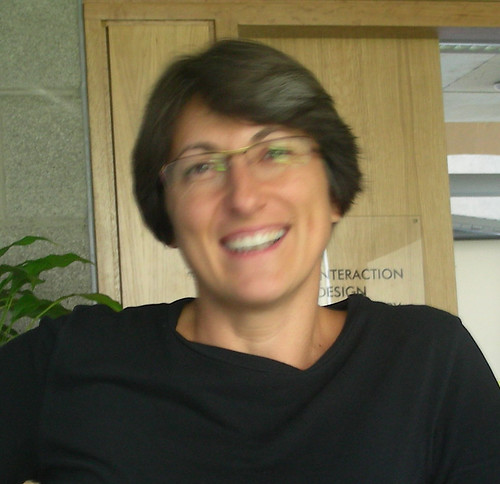
Daniela Petrelli from the University of Sheffield is visiting the IDC as part of the "Memoir" Project.
At Sheffield, Daniela teaches electronic publishing, digital multimedia and web-design.
Her current research interests are:
- information access, including multilingual (searching information in many languages) and multimedia (particularly historical archives of images and videos);
- information and knowledge management for sharing in manufacturing (Rolls Royce jet engine design, building and worldwide maintenance);
- personal digital memories.
Daniela moved to the UK in 2000 and previously I was a researcher at IRST in Trento, Italy where she did research on adaptive and mobile guides for museums, natural-language based interaction, intelligent interface interaction.
In a far past (1990-1993) she was at the Italian Telecon Research centre and worked on CSCW and teleconferencing systems mainly doing interface design and development.
The Memoir project will last for 4 years and is about the capturing, storage, organization, retrieval and sharing of multimedia personal memories. Personal memories are intended at large: email, documents (word, excel, powerpoint), messages on the phone, personal pictures, videos etc. Accessing means not today but in 10, 20 or more years time.
Several people are involved:
- 4 academics from the University of Sheffield (Daniela is one of those)
- 3 research associates (just recruited, 1 HCI, 1 Video/Image, 1 IR)
- 3 senior visiting fellows for 3 months on: ethics of memories, psychology of memories, social history.
Daniela's interest in the project is about sharing memories in a family context across different generations (children, parents, grandparents but siblings and cousins are welcome too ;-)
The goal is to design a something to facilitate the capturing composition and sharing of the memories across generations of tightly connected people.
Thursday, October 05, 2006
VIP visit to IDC
Today, Jim and Margo Keyes visited the Interaction Design Centre at UL. They enjoyed a number of our demos, from JJ's sound sculpture, MetaMusic, Motes and the DBMT haptics.

Thursday, September 28, 2006
MetaMusic (a.k.a. Abaltat) handover

For the past two years, a dedicated team of programmers and computer musicologists in the Interaction Design Centre in the Department of Computer Science and Information Systems at the University of Limerick have been working on developing a novel software package. The idea was to create software that automatically can compose music to video clips, such as television advertisements promos and documentaries, that would otherwise cost producers a lot in terms of music royalties.
The project's team-leader Mikael Fernström, the co-originator of the project and well-known computer-music composer, commented that “I’ve been working for so many years on finding new kinds of music by means of computing, but when the Abaltat team approached us as and asked if we could do popular music, we said Why Not!“
The resulting software prototype is now being transferred to an exciting new Irish start-up company, Meiticheol Teoranta, trading as Abaltat. Abaltat is located in Spiddal, Co. Galway. The development was sponsored by Enterprise Ireland’s Innovation Partnership programme. Abaltat is also supported by Údarás na Gaeilge, The Western Development Commission and Enterprise Equity Investment Fund.
At the recent IBC trade show in Amsterdam, Abaltat previewed AbaltatMuse. The software and was nominated for the prestigious IABM Peter Wayne Award. The product was also selected as pick of the show by Broadcast Engineering magazine and has been shortlisted by TVB Europe for their IBC awards to be announced in October
Mr Justin McCarthy, one of Ireland’s most well-known video editors and Technical Director of the company said "Based on our market research and the response at the international IBC trade show, we are confident that we have a worldwide success on our hands. The future of broadcasting includes the ability to deliver programming over all media including the web. The issue of music royalties is becoming more and more of a hinderance. Our software solves this problem giving editors an exciting and creative solution. Editors can now control how the music is written, using an editing interface.
The television world will never sound the same...
Special thanks to Eoin, Ian, Tony and Brian who have worked so hard, for so long, on delivering this vision. We'll do it again, next week ;-)
Thursday, September 21, 2006
Good Luck Steve!
After years of service, Stephen has left the IDC for greener pastures!
Here he is pictured at his going away party, already scared by what awaits him...
Good Luck Steve, and thanks for all your work with us!

Here he is pictured at his going away party, already scared by what awaits him...
Good Luck Steve, and thanks for all your work with us!
Thursday, September 14, 2006
Interactive Media and Music Technology 2006
It's that happy time of the year. I-media and MusTechs are finalising their projects. We're all hoping that they'll do really well, and make us proud in the DAWN2006 show.
Monday, September 11, 2006
Limerick Milkmarket
So, our next design is Limerick Milkmarket. Why the hell am I writing this, it should be Parag! Anyhow, we've created an on-line cookbook.
We have spread some postcards to get people to send us their recipes. Hopefully we'll get some healthy suggestions.
We have spread some postcards to get people to send us their recipes. Hopefully we'll get some healthy suggestions.
Sunday, August 13, 2006
Thursday, August 10, 2006
The Portal Experience
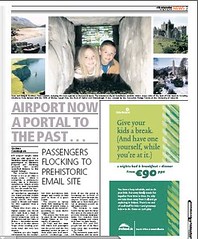
Here's the most relevant article written on the Portal in the past couple of weeks. It appeared in the Irish Independent.
Now that the Portal's exhibition is nearly over, a brief overview of people's interactions with it can be seen here.
The images "donated" by people to the Portal Gallery can be seen here.
Wednesday, July 19, 2006
The Portal Up and Running at Shannon Airport
The Portal is finally up and running in the transit lounge of Shannon Airport. A lot of interesting interactions around it and very positive feedback so far!
Monday, July 10, 2006

Thursday, July 06, 2006
Portal getting ready for Shannon Airport
So, this is it. On Tuesday, the contraptions we've built will move to Shannon. As the core team is now quite [too] small, we will probably ask all IDC:ers to help out at some stage.
Monday, June 26, 2006
ICAD2006
Last week, Cyberviking and Braz were at ICAD2006 in London. Apart from presenting our paper, this year's competitive activity was to sonify a number of concepts:
The results of Group I can be heard here.
- Communism
- Red
- Drama
- Diversity
- A Pint
- A Dragon
- C'mon England
The results of Group I can be heard here.
Friday, May 26, 2006
NomadS Seminar: Supporting Mobile Work: Approaches to designing technology
On Thursday, MAy 25th, the NomadS project hosted an open seminar: "Supporting Mobile Work: Approaches to designing technology". The seminar was aimed at discussing how the design of novel technological tools could improve the lives of "nomadic" workers. The seminar was sponsored by the NomadS through its funding bodies, Science Foundation Ireland and IRCSET. The seminar saw presentations of the work conducted on NomadS, and the participation of an invited speaker: Dr. Monika Buscher, University of Lancaster (UK).
Monika is an ethnomethodologist, ethnographer and designer interested in the study of people's practical action and the design of innovative technologies. She works with landscape architects, health professionals, patients, software designers, industrial designers, and sociologists, currently in a project called PalCom, which is part of the EU’s 6th Framework Programme.
Monika's talk was entitled "Extreme nomads: Mobility and embodied conduct in emergency teamwork".
Emergency situations demand fast, effective creation/preparation/maintenance of many different work places and connecting routes under often extremely chaotic conditions. It requires collaboration between diverse actors. Police, fire services, and medical personnel need to secure the scene, create access routes and ensure they are kept free, categorise, treat and transport victims, handle hazardous materials or deal with contamination, and coordinate work with emergency service personnel in emergency vehicles, dispatch centres, and hospitals. Communication is crucial, but often difficult under immense time pressure, in extremely complex and often dangerous settings. Embodied conduct plays a crucial role for communication and the coordination of mobility and the creation/preparation/maintenance of workplaces and routes. In this paper I discuss ethnographic observations from training exercises for major incidents and some prototypes for technological support for communication and coordination in emergency situations with a focus on the role of embodied conduct.
Thanks to all who participated!
Monika is an ethnomethodologist, ethnographer and designer interested in the study of people's practical action and the design of innovative technologies. She works with landscape architects, health professionals, patients, software designers, industrial designers, and sociologists, currently in a project called PalCom, which is part of the EU’s 6th Framework Programme.
Monika's talk was entitled "Extreme nomads: Mobility and embodied conduct in emergency teamwork".
Emergency situations demand fast, effective creation/preparation/maintenance of many different work places and connecting routes under often extremely chaotic conditions. It requires collaboration between diverse actors. Police, fire services, and medical personnel need to secure the scene, create access routes and ensure they are kept free, categorise, treat and transport victims, handle hazardous materials or deal with contamination, and coordinate work with emergency service personnel in emergency vehicles, dispatch centres, and hospitals. Communication is crucial, but often difficult under immense time pressure, in extremely complex and often dangerous settings. Embodied conduct plays a crucial role for communication and the coordination of mobility and the creation/preparation/maintenance of workplaces and routes. In this paper I discuss ethnographic observations from training exercises for major incidents and some prototypes for technological support for communication and coordination in emergency situations with a focus on the role of embodied conduct.
Thanks to all who participated!
Change
It's been a good day. Interesting seminar from Nomands project.
We all need to start to prepare [realise] that the IDC this autumn will be a different place, as almost half of the postgrads finish or bugger off. My ultimate fear is that I'll be the only techie left. I'll have nobody to talk to [or few].
Perhaps I should get a real job and develop Irish Homeland Security ;-)
We all need to start to prepare [realise] that the IDC this autumn will be a different place, as almost half of the postgrads finish or bugger off. My ultimate fear is that I'll be the only techie left. I'll have nobody to talk to [or few].
Perhaps I should get a real job and develop Irish Homeland Security ;-)
Monday, April 03, 2006


Sunday, March 05, 2006

Wednesday, January 25, 2006
IDC Poll 25 January 2006: Movies and Celebrities
Looks like the IDC people are up there with A-B-C and D list celebrities, and have featured in a number of movies!
Appearances of IDC folks can be found in "Braveheart", "Michael Collins" (which also features Daniel's coat), and "a low-budget movie while Summering in the Hamptons in 1998". The wonderful walking skills of IDC people were also put to use in "walking past in the background" scenes in two German films (unknown titles) in Berlin 2000, and in a "people strolling down the street" scene for "Law & Order" in 2005.
Besides the silver screen and TV appearances, the world of theatre has been invaded by an IDC presence. Dr. Gabriela Avram recounts: " I had a part in a theater play when I was 6. I played about 30 times on a real stage (Timisoara National Theatre), with top class actors, in an excellent play. I was impersonating the daughter of a famous Romanian writer, and I was chosen not because I was cute or smart, but because I had the same name as hers!"
As for celebrity sightings, the juicy list includes: Madonna, Mel Gibson, Nicky from Westlife (met by Darragh at one of their concerts), Ian Dempsey, Alan Rickman, Bertie, Prince Albert (ask Tony), Thandie Newton (ER, "Crash", "Mission: Impossible II"), Jewel Staite (Kaylee from Firefly/Serenity), Faye Dunaway (Gabriela thinks it was her) Bill Gaver, Liam Bannon and Mikael Fernström (met by several IDC members in a number of occasions).
Appearances of IDC folks can be found in "Braveheart", "Michael Collins" (which also features Daniel's coat), and "a low-budget movie while Summering in the Hamptons in 1998". The wonderful walking skills of IDC people were also put to use in "walking past in the background" scenes in two German films (unknown titles) in Berlin 2000, and in a "people strolling down the street" scene for "Law & Order" in 2005.
Besides the silver screen and TV appearances, the world of theatre has been invaded by an IDC presence. Dr. Gabriela Avram recounts: " I had a part in a theater play when I was 6. I played about 30 times on a real stage (Timisoara National Theatre), with top class actors, in an excellent play. I was impersonating the daughter of a famous Romanian writer, and I was chosen not because I was cute or smart, but because I had the same name as hers!"
As for celebrity sightings, the juicy list includes: Madonna, Mel Gibson, Nicky from Westlife (met by Darragh at one of their concerts), Ian Dempsey, Alan Rickman, Bertie, Prince Albert (ask Tony), Thandie Newton (ER, "Crash", "Mission: Impossible II"), Jewel Staite (Kaylee from Firefly/Serenity), Faye Dunaway (Gabriela thinks it was her) Bill Gaver, Liam Bannon and Mikael Fernström (met by several IDC members in a number of occasions).
Monday, December 12, 2005

Wednesday, November 30, 2005
"Hedonic Computing" by Dr Barry Brown
Dr. Barry Brown of the Dept. of Computer Science, University of Glasgow has visited the IDC and has given a talk on Monday, November 28th on “Hedonic computing: the computer science of leisure and enjoyment”, followed by open discussion.
Abstract:
This talk explores the opportunities for a ‘hedonic computer science’. Within many parts of computer science there has been a subtle change in approach: from video conferencing to mobility, from flight simulators to video games, from artificial intelligence to A-life. These changes open opportunities for a computer science that is as concerned with enjoyment as much as it is with formalism. I discuss how we might take leisure seriously as a goal within computer science. In particular, I discuss three examples of playful technologies - a piece of RCA designed furniture known as the ‘drift table’, an online virtual environment called There, and a collaborative tourism system we have designed. These examples suggest how we might build systems differently to support activities such as wasting time, sociability and enjoyment.
Barry Brown, Equator Research Fellow, Dept. of Computing Science, Uni. of Glasgow
Abstract:
This talk explores the opportunities for a ‘hedonic computer science’. Within many parts of computer science there has been a subtle change in approach: from video conferencing to mobility, from flight simulators to video games, from artificial intelligence to A-life. These changes open opportunities for a computer science that is as concerned with enjoyment as much as it is with formalism. I discuss how we might take leisure seriously as a goal within computer science. In particular, I discuss three examples of playful technologies - a piece of RCA designed furniture known as the ‘drift table’, an online virtual environment called There, and a collaborative tourism system we have designed. These examples suggest how we might build systems differently to support activities such as wasting time, sociability and enjoyment.
Barry Brown, Equator Research Fellow, Dept. of Computing Science, Uni. of Glasgow
Subscribe to:
Posts (Atom)