Thursday, January 24, 2008

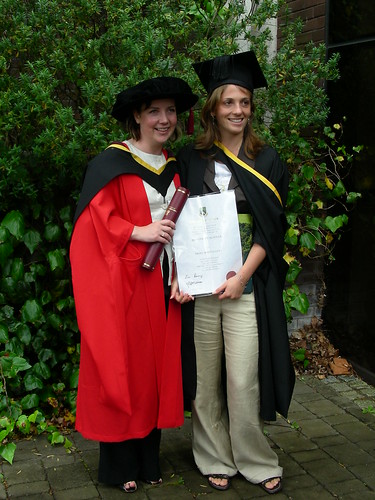
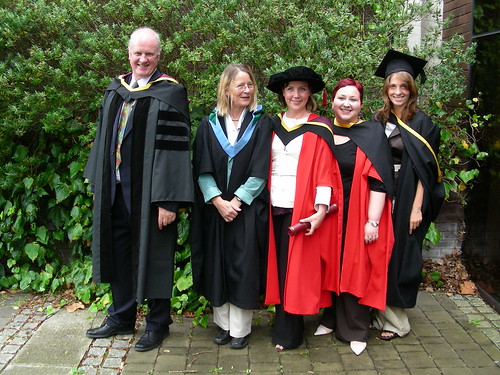
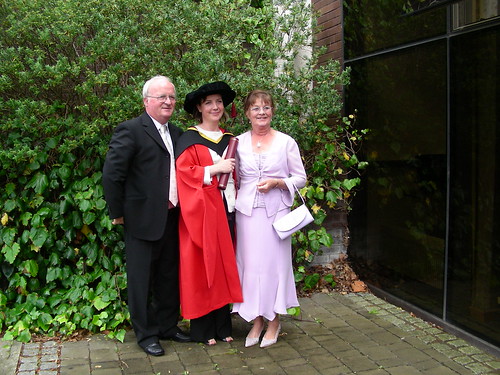
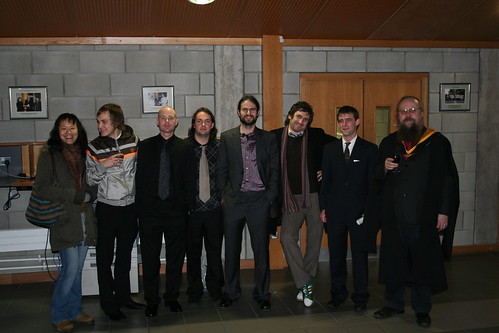
Congratulations to the Interactive Media and Music Technology Classes!

At the Winter Conferrings held on January 22nd, we celebrated the Interactive Media and Music Technology Classes of 2007/2008!
Former IDC researcher Darragh Murphy also graduated in absentia with an MSc by research.
Well done everyone!
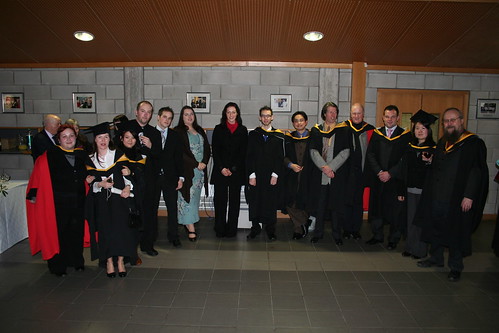
IMedia Grads 2008

MusTech grads 2008

Wednesday, January 09, 2008

"Settings for Collaboration: The Role of Place"

Luigina Ciolfi and Liam Bannon are co-editors, together with Geraldine Fitzpatrick (University of Sussex, UK) of a special issue of the Computer-Supported Cooperative Work Journal on "Settings for Collaboration: the Role of Place". The special issue features papers discussing the role and importance of the notion of place for understanding collaborative settings mediated by technology. All papers are now available on the Journal's on-line first edition. The printed issue will appear in March.

Tuesday, December 18, 2007

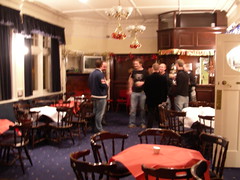
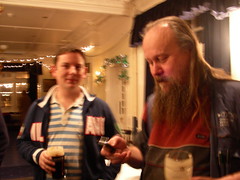
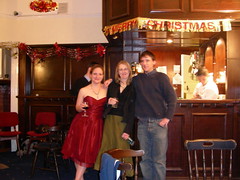
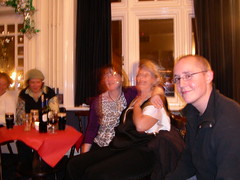
IDC Christmas Celebrations

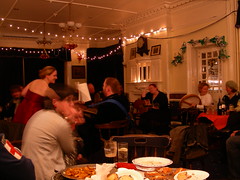
The IDC has celebrated the Holiday Season in style last night at the Shannon Rowing Club in Limerick City.
As usual, good food, drink, conversation and music features heavily in the proceedings!

DSCN3223

DSCN3217

DSCN3237

DSCN3253

DSCN3259

DSCN3227

DSCN3219

DSCN3248

DSCN3214

Friday, November 30, 2007

Guests from Tip IT

Yesterday, we had a group of Creative Multimedia students from Tiperarry Institute of Technology, together with their lecturer as visitors in the IDC.

All started a few good weeks ago, with Bernard following the Jaiku channel used by Gabriela and her students (Bernard recalls jaikus about Doug Engelbart received on his mobile phone while he was walking his dog:).

After that, Gabriela finally made it to an OpenCoffee in the Absolute Hotel and met Bernard in person. Gabriela invited Bernard to give a talk on podcasting to her students, and Bernard suggested he could bring some of his students with him.

And then all happened yesterday - Bernard spoke to the UL+TippInst students about podcasting, jobs and entrepreneurship, asked his students to talk about their own work and encouraged the audience to ask questions. The students were a bit shy in the beginning, but when he invited them to have a look at his podcasting gear, most of them couldn't resist the temptation and the ice was broken. The two groups of students had the chance to mingle for a few minutes afterwards!

After the lecture, the TippInst students visited the IDC, where Liam talked to them about the Interaction Design Centre and our way of looking at technology, and Lui spoke about previous and current IDC projects. The visit finished with the grand tour and a closer look at some of our "reliques" - the Shannon Portal, the recipe pyramid...

It was an interesting exchange and I have the feeling we all learned from it!

Wednesday, November 14, 2007

PTBYBO 3

The Interaction Design Centre and the Center for Computational Musicology & Computer Music proudly present:
PTBYBO 3
Date: 21st of November 2007
Time: 14:00-17:00
Venue: Kilmurry Hall, University of Limerick
All are welcome!

PTBYBO 3 will present Hellström and Bowers’ latest efforts at circuit bending and live coding (where, respectively, hardware and software are hacked before your very eyes and ears) to explore live sound/image relations in an improvised performance. The occasion will feature the Irish debuts of Ohm-My-God (an environment in which random electronic circuits are constructed) and My Little Dreamachine (a miniaturization of Brion Gysin and Ian Sommerville’s hallucinogenic Dreamachine, the behaviour of which is variously sonified and visually transformed and projected). Generally, lights will flash and circuits will blip with an uncommon intensity as Hellström and Bowers work feverishly to transport all our bodies, minds and souls from the beginning of the end. A Performance To Blow Your Brains Out, surely.

A seminar discussing the techniques in PTBYBO 3 and relating them to larger issues in interaction design and the construction of new instruments for musical expression will be given by Hellström and Bowers in Kilmurry Hall, University of Limerick, the 21st of November 14:00-17:00.

Links
http://schhh.se/
http://www.onoma.co.uk/
http://suborderly.blogspot.com/2007_03_01_archive.html

Biographies
John Bowers
John Bowers is currently a Professorial Research Fellow in the Department of Design at Goldsmiths College, University of London, UK, and a Visiting Research Fellow at the School of Music, University of East Anglia, UK. As an improvising musician, John is part of Tonesucker, an improvising noise metal electric guitar duo (CD Slaughterhouse available on Onoma Research), the Gentlemen of Circuitry, a quartet who play antique and homemade electronic instruments, and the electro-acoustic improvisors The Zapruda Trio (CD Live at Smallfish available on vision-of-sound), amongst other collaborations. Solo work includes The Dial: Have you been to Hilversum? (broadcast by Resonance FM, London), Do It Yourself Silence and Silence Silenced (contributed to the CD A Call for Silence, Sonic Arts Network), and Atonement for Violin Quartet (Norwich Gallery, UK), a four day long performance-installation-webcast revisiting the instrument destruction preoccupations of Fluxus artists. John is co-founder of the Onoma Research music label. A monograph specifying John's characteristic approach to music, social science research and technical affairs, Improvising Machines, is available from http://www.ariada.uea.ac.uk/ariadatexts/ariada4.

Sten-Olof Hellström
Sten-Olof has been active as a professional composer since 1984 and gained a Masters of Music in composition at University of East Anglia, England 1990. He has been employed as a researcher and composer at the Centre for User Oriented IT Design (CID), Royal Institute of Technology (KTH) since 1997. As a researcher Sten-Olof has mainly worked in the field of Human Computer Interaction where he has been part of several major EU-funded long-term research projects such as eRENA and Shape. He is also very active in the field of sonification (representing data with sound). One example of current work is the construction and development of a computer interface for the visually impaired.  Sten-Olof’s main occupation and profession is as a composer working with electro-acoustic music. His music has been performed and broadcast around the world and he is also active as a performer playing live electro-acoustic music on his own and with others such as Ann Rosén, John Bowers and Simon Vincent. Sten Olof is also part of the performance group the Zapruda Trio based in England.

Questions and queries
Please contact Mikael

Wednesday, November 07, 2007

Talk: "Interaction design in practice: on the construction of an interactive object"

The IDC is hosting a research talk this Friday, 9th of November: "Interaction design in practice: on the construction of an interactive object", by Dr. Cristiano Storni, University of Trento (Italy)

Abstract:
The talk will provide an overview of one the two case studies that I have
analyzed in my research. The case is about the birth of a new Interaction
design working prototype. The work is based on extensive observations based
on the idea to map the trajectory of events and transformations that bring
from the first instantiation of an idea to its final realization.
The presentation will focus on the methodological aspects of the research by
bringing to the fore the importance of fetishistic ethnographic accounts. It
will follow an overview of some of the new concepts and conceptual
distinctions proposed in the analysis such as: pro-ferences vs. re-ferences,
sewing practices, in-jects, thing vs. objects.
The talk is aimed at provoking conversations with audience about daily
design practices and experiences.

Bio
Cristiano Storni holds a degree in Human/computer interaction from the
University of Siena and a Ph.D in Information Systems and Organization from
the Department of Sociology and Social research (Faculty of Sociology of the
University of Trento), with a Thesis on Design practices and the
construction of objects. He has worked as senior engineer in several IST
European Projects on Information systems, Knowledge Management, E-Government
and, more recently, e-Health. E-Health and Gerontechnology is the main
research area he is currently involved with. His interests range from SSIS
(Social Studies of Information Systems), HCI, Interaction Design and
Participatory Design, to Semiotics, ANT (Actor Network Theory), STS
(Science and technology studies) and Ethnography/Ethnomethodology.
He is concerned with social, organizational, existential and human aspects
of technological innovation and design. He has presented several research
papers in national and international conferences.

Time: 10.30
Venue: CSIS meeting room, Computer Science Building, CS2037

All welcome!

Friday, October 19, 2007

Minister Éamon Ó Cuív TD visits Abaltat offices

Éamon Ó Cuív TD, Minister for Community, Rural & Gaeltacht Affairs, visited the Abaltat offices in Spiddal on Friday 19 October.

Abaltat Express features on TVB Television Broadcast 2 Minute Drill

Abaltat Express, the latest software release from Abaltat, a company started from an IDC research project, features in a www.televisionbroadcast.com 2-Minute Drill:

http://www.televisionbroadcast.com/TMD/archive/2007/101907-two-minutedrill.mp3

Thursday, October 04, 2007

Abaltat Muse wins award at IBC 2007

The company that was born out of the White Hunter/Metamusic research project in the IDC has won yet another award in IBC in Amsterdam...


Justin McCarthy, Technical Officer, was also interviewed on Radio IBC

www.http://www.radioibc.com/myradioibc

Click on "Abaltat - Music Composition For Dummies!" to hear the podcast

Wednesday, October 03, 2007

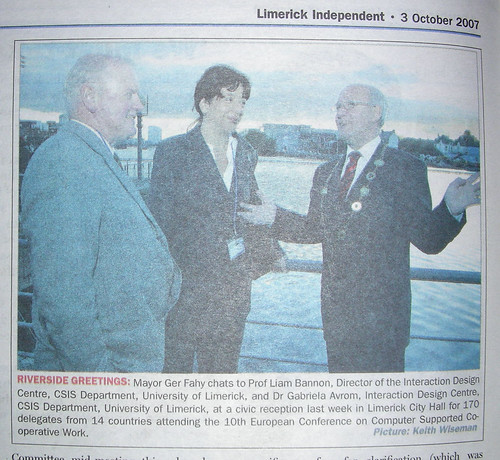
Limerick Independent

civicreception

New IDC publications at ICHIM 2007

The IDC will be well represented at the International Cultural Heritage Informatics Meeting (ICHIM 07) in Toronto at the end of October. Two papers featuring IDC work have been accepted to the conference:
"Visitors' contributions as cultural heritage: designing for participation", by Luigina Ciolfi, Liam Bannon and Mikael Fernström, discusses the approach to designing interactive exhibitions that allow for visitors' interactive participation, such as "Re-Tracing the Past" and the "Shannon Portal".
"MUSTEL: Framing the Design of Technology-Enhanced Learning Activities for Museum Visitors" presents a novel frame to designing educational museums technologies developed by the MUSTEL group within the EU Kaleidoscope Network of Excellence. Liam Bannon wrote the paper in collaboration with Palmyre Pierroux and Dagny Stuedahl (University of Oslo, Norway), Kevin Walker (London Knowledge Lab), Victor Kaptelinin (Umeå University, Sweden) and Tony Hall (National University of Ireland, Galway).

Sunday, September 30, 2007

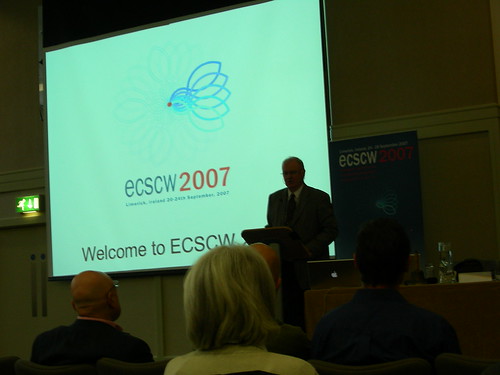
Success for ECSCW 2007 in Limerick

Prof. Liam Bannon, Director of the IDC, chaired the 10th European Conference on Computer-Supported Cooperative Work (ECSCW 2007), which took place at the Hilton hotel in Limerick City last week. The conference was generously sponsored by Science Foundation Ireland, IBM, Microsoft Research, Limerick Travel and Limerick City Council, with support and resources from the University of Limerick.

DSCN2652

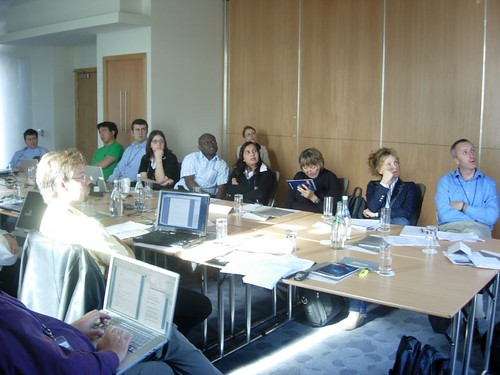
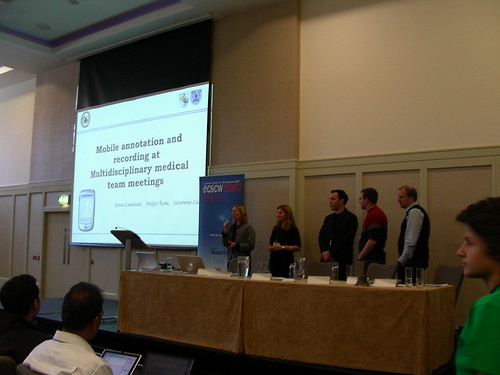
Many other IDC members were involved in the planning and management of the event, which saw over 150 participants from all over the world converge on Limerick to attend the Conference. ECSCW 2007 featured 10 workshops, 3 masterclasses and a Doctoral Colloquium over two days; and a single-track plenary 3 days that have included presentations of 23 research papers, two panels, posters and demo exhibitions and two invited keynote speakers.

DSCN2739

IDC members co-organised and participated in a number of workshops, including "The Challenges of Collaborative Work in Global Software Development" (Gabriela Avram, Liam Bannon, Anders Sigfridsson, Daniel Sullivan, Anne Sheehan) and "Beyond Mobility: Studying Nomadic Work" (Luigina Ciolfi).

DSCN3647

DSCN2576


The Student Volunteers were co-ordinated by IDC members Michael Cooke and Anders Sigfridsson, with the support of Emanuela Mazzone (University of Central Lancashire), formerly a visiting student at the IDC.
Annette Aboulafia served as demo chair and coordinated the demo exhibition.

DSCN2826

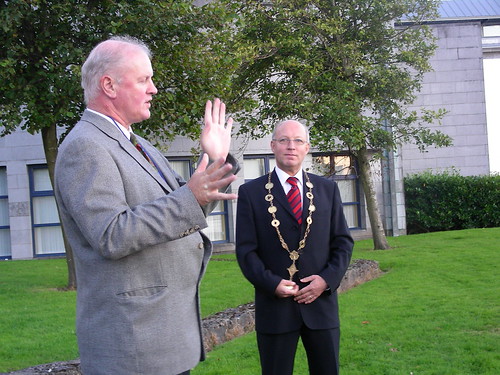
The conference delegates were welcomed by Prof. Vincent Cunnane, UL Vice-President Research, who officially opened ECSCW 2007, and greeted by the Mayor of Limerick, Cllr. Ger Fahy, who hosted a reception at City Hall.

DSCN2773

Other social events included the conference opening reception at the Georgian House, and the conference banquet at Dromoland Castle.
The final event of the conference also featured a UL contribution, as Prof. Micheal O'Suilleabhain, director of the Irish World Academy of Music and Dance, delivered ECSCW 2007 final keynote, "What makes a traditional Irish session work", joined on stage by colleagues Niall Keegan and Sandra Joyce.

DSCN3056

The next ECSCW Conference will take place in Vienna, Austria, in September 2009.

Friday, August 31, 2007

Congratulations to Marilyn and Iride

It's graduation time again, and the IDC celebrates Marilyn Lennon, PhD and Iride Bartolucci, MSc by research. Congrats to Iride and Marilyn on their achievement!

DSCN2434

DSCN2452

DSCN2438

DSCN2454

Thursday, August 30, 2007

Dawn 2007 Opening on Monday

DAWN’07 - DIGITAL ARTS WEEK NOW 2007 at UL, 3rd o 7th of September 2007
For the eight year in a row, the University of Limerick offers an exhibition and concert of Masters’ student work. It’s the students from the Masters programmes in Music Technology and Interactive Media that showcase their end-of-year work. The exhibition shows technology, media and music that may be the start of tomorrow’s revolution. With the freedom given to the students to envisage where current trends are going and what is possible with the latest computer hardware and software, we have the opportunity to see demonstrations and examples of what a not too distant future has to offer.
The Computer Science and Information Systems Department at the University of Limerick runs both programmes. What makes UL’s programmes so special is that they recognise the importance of interdisciplinary work, bridging traditional divisions between arts and science.
The faculty at UL teaching on the two programmes are highly enthusiastic about the exhbition. For example:
Jürgen Simpson, the Course Director of the Music Technology programme said “This is the one of the few programmes in Ireland where you can get a Masters degree in electroacoustic music composition. Some students also choose a scientific approach and do work in areas such as musical user interfaces, sound synthesis software and audio processing – which we know are increasingly important with the evolution of music and media on the Internet”.
Mikael Fernström, the Course Director in Interactive Media enthusiastically commented that “Over the last few years we have seen our students research and develop some extremely novel ideas and technologies. Some of our past students have started companies based on their ideas, others have become specialists or teachers in both technology and digital art. I have a strong feeling that many of this year’s projects may follow the same successful path.“
UL also has two undergraduate programmes, in Digital Media Design and in Music Media and Performance Technology. The Computer Science department has built a new laboratory with state-of-the-art digital music and media equipment and software to facilitate the new courses that will continue to strengthen UL’s position in an increasingly digital world.

Admission to the exhibition and to the concert is free.
Official opening: 18:00, 3rd of September, Ground floor atrium, Foundation Building.
Concert: 20:00, Performance Art Centre, Foundation Building
Exhibition: 3rd to 7th of September, 10:00-17:00, Shuman Building
For details about the works, see http://www.csis.ul.ie/imedia/dawn07/

Sunday, August 19, 2007

Bridget Hickey


Bridget Hickey is dead. She graduated with a 2.1 in last year's (2006)Masters programme in Interactive Media. She was last seen alive the 7th of August. She was found dead the 16th of August. Her course web site is still there. May she rest in peace.

Thursday, August 02, 2007

Summer guests in the IDC

Today we had not one, but two guests in the IDC. Both also gave talks at UL(organised in association with the CSCoP).


Michael Kölling from the University of Kent and Alexander Troussov, the Chief Scientist of the IBM Dublin Center for Advanced Studies visited the IDC this afternoon, after giving two extremely interesting talks at UL in the morning. Details on the talks can be found on the socGSD project blog.

Liam himself (just back from the Ferroe Islands) guided the guests in "the grand tour" of the IDC.
Future collaboration opportunities were also discussed.

Friday, July 27, 2007

Muireann leaving today...

Muireann O'Brien, secondary school teacher at the Carrigaline Community School in co Cork has spent 8 weeks with us this summer, working with the socGSD team as participant in the STARs SFI programme.
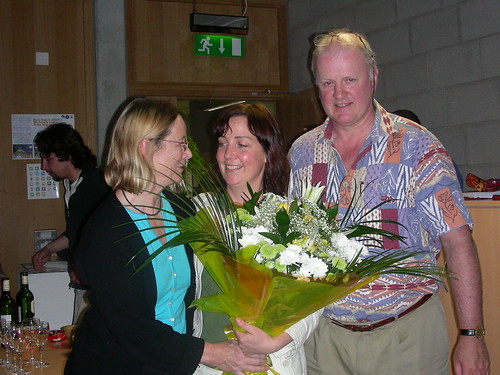
As time went by, she became part of the big IDC family...

Besides finding out about the collaboration challenges in Global Software Development from the members of the socGSD team, she also had the chance to familiarise herself with the work of the other groups in the IDC.

We all hope she's taking back to her school a bag full of stories and resources!

Good bye, Muireann! It was great having you around this summer!

Tuesday, July 10, 2007

Dr Eva Hornecker visiting the IDC

The IDC "Shared Worlds" project is hosting a Talk by Dr Eva Hornecker, Pervasive Interaction Lab, Open University, UK. The talk will take place on Wednesday, 11th of July, 2.30 PM, in ERO-008.

Title: "Social interaction in computer-augmented environments - towards an understanding of users' experience in interactive spaces"

Abstract: With technological advances, computing progressively moves beyond the desktop into new physical and social contexts. This talk will focus on the user experience in interactive spaces, which embed computing in the real world, and enable users to control and interact with computers through tangible devices and full-body interaction. Freeing users from the desktop and integrating computer output into the
everyday world in particular is expected to support collaborative activities and communication. Yet research so far has tended to focus on the technological opportunities and less on the user experience and the social effects of these new systems. The talk will explain 'tangible interaction' as an umbrella term encompassing different technical and disciplinary approaches. It will introduce a framework which contributes to understanding the user experience of 'tangible interaction' and to design approaches that address the social use context. This is exemplified through a range of practical examples.

Bio: Dr. Eva Hornecker is a Visiting Research Fellow at the Open University and member of the Pervasive Interaction Lab where she conducts her research project which centers on the talk's theme. She was program co-chair for the first international ACM conference on Tangible and Embedded Interaction (TEI'07). Before coming to the OU she was acting lecturer at the Technical University in Vienna and at the University of Canterbury in New Zealand, and worked as a visting research fellow on the Equator project at the University of Sussex.

Thursday, May 24, 2007

Congratulations to Bruce and Luisa on the birth of their son

Congratulations to Bruce and Luisa on the birth of their first child, baby Daniel, he's a strapping 8 pounds and 12 ounces. He was born today in Limerick at 17:53.

Wednesday, May 23, 2007

Congratulations to Dr Marilyn Lennon

The IDC celebrating a new PhD! Marilyn Lennon has successfully defended her thesis "Reflective Prototyping - Concretising Reflection in Interaction Design". Examiners were Prof. Jacob Buur from the University of Southern Denmark, and Prof. Eamonn McQuade from UL College of Engineering.
Here's Dr Lennon celebrating her success with her supervisors, Prof Liam Bannon and Dr Annette Aboulafia.

DSCN1966

Congratulations to Dr Marilyn Lennon on her achievement!

Wednesday, April 18, 2007

UL IDC to host first Irish HCI meeting

The Interaction Design Centre at the University of Limerick will host a 1-Day Workshop on the topic of Human-Computer Interaction in Ireland (iHCI07) to be held at on May 2nd, 2007.
The purpose of this Workshop, which we hope will become an annual event, is to promote networking and collaboration among academics and practitioners in the broad area of people interacting with technology, and as such, the topic includes such areas as: usability studies, interface design and evaluation, accessibility issues, cognitive ergonomics, human factors in computer systems, computer supported cooperative work, human computer interaction, multimedia and interaction design.

Our intent with this initial meeting is to bring together researchers, practitioners and teachers interested in the field, to document past and current activities, and to setup a database of information in this area on an all-Ireland basis. To this end, this first Workshop will focus on brief presentations from all the participating groups.

We envisage that this Workshop will help provide a better profile for individuals and groups involved in the HCI area in Ireland, as currently, despite the size of our software industry, we have not yet developed as significant an impact as one might expect, given the importance of our topic.

Tuesday, April 17, 2007

New Shared Worlds Journal Publications to Appear

The forthcoming May issue of IEEE Computer will feature a research paper by the IDC Shared Worlds team documenting the Shannon Portal: "The Shannon Portal Installation: Interaction Design for Public Places".
Another Shared Worlds paper by Luigina Ciolfi discussing the Shannon Airport installation from the point of view of affective computing will appear in the forthcoming issue of CoDesign, and will be presented at the Affective Communication in Design conference in Leeds in June.
And more are on the way!

Sunday, April 01, 2007

The IDC to be privatized - becomes independent research institute

A group of private benefactors (who would like to be anonymous) have donated an undisclosed amount to buy the entire Interaction Design Centre, its staff, faculty and students from UL, to become a fully privatized international research institute. It is believed that the amount of funding involved is at least forty-two million Euro.

One of our major discoveries that attracted the investors was a new form of computing that eventually will enable the development of computers capable of infinite improbability states. While computers up until now are based on logical gates switching between ones or zeroes (true or false), our new technology will most often use the state of “maybe”. To continue our groundbreaking work in Human-Centred Computing, it is envisaged that the emergence of femto-technology will enable us to create a pain-free diode, which is believed to be at the core of the development of humanoid robotics. Further more, the new institute’s President claims that we have a new framework for understanding the socio-technical reality that will be the foundation of the approaches to software development and communication technologies. In a comment, a spokesperson said that:

“We all know that things like email-spam and pornography has been central to the popularity of the World-Wide Web. It is now time to re-frame our thinking and look at a fundamental change in global perspectives. For example, if for each spam-message the spammer had to make a donation to a charity, or, if porn-sites changed their approach on narrative structure so that users could be enriched with an educational experience in for example anatomy and philosophy as well as looking at more evolutionary trends.”

The working title for the project is The Institute for Life, the Universe and Everything (ILUE)

Tuesday, February 06, 2007

Mikael invades England

Mikael delivered the keynote at the International Workshop on Interactive Sonification 2007 in York. UK.

There were many interesting papers and works-in-progress presented throughout the day, and many really good demos.
The previous day, we had a Management Committee meeting in the COST Action ConGas. Next meeting, which is the last in this action, will be in Reykjavik in May.

Thursday, January 25, 2007

Mikael on Rte Radio One


Mikael was on today's Mooney Goes Wild on RTE Radio One, talking about sounds and the sounds people hate. You can listen to the clip here (MP3).

Thursday, January 04, 2007

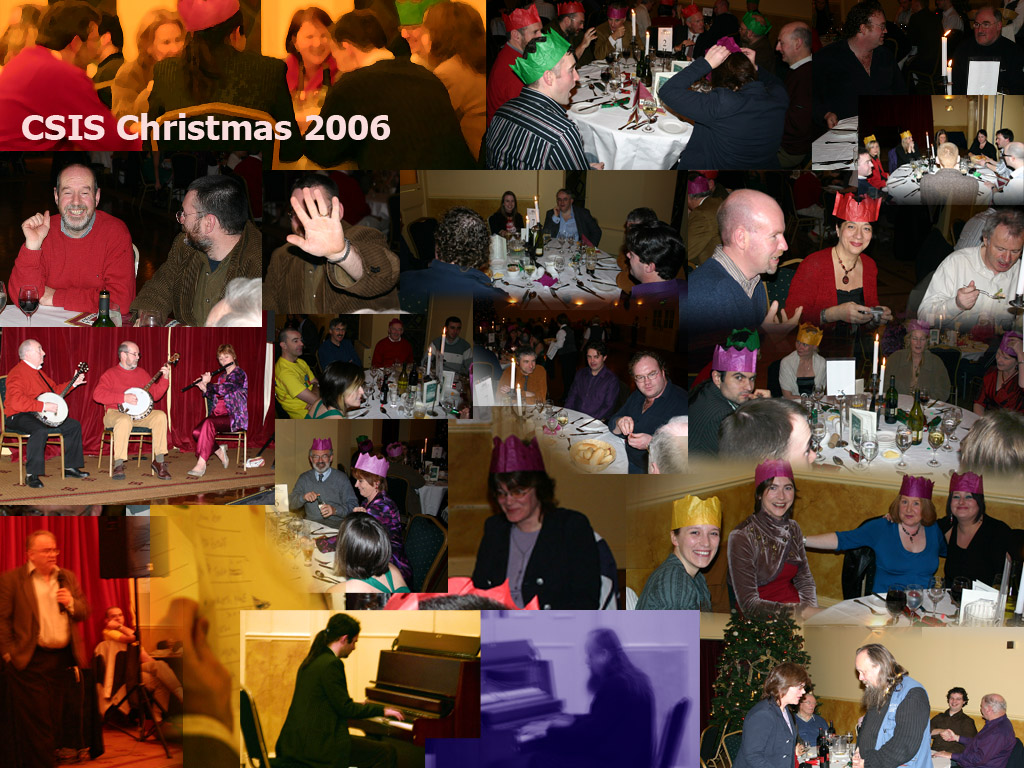
This year's CSIS Christmas Party!

This year, our head of department decided to organise a big Christmas party not only for the teaching and admin staff, but also including all the related research centers! Up to 100 people showed up at the venue, and enjoyed the night!

The result exceeded all expectations! Have a look yourselves:


Thanks to Colm for taking good quality pictures and for this nice collage! You're a pro!

Thursday, December 21, 2006

Winter Graduation 2006

It's that happy time of the year - again. We had Nicola getting her M.Sc. by research and Andy his Ph.D.

The Interactive Media class received their awards, and so did the Music Technology class. We wish you all the very best!


Friday, November 24, 2006

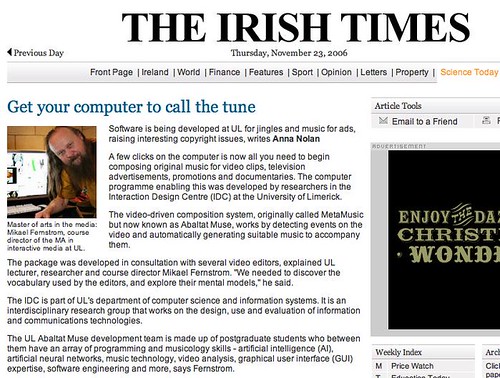
IDC and MetaMusic in the media

This week, there has been excellent media coverage of the IDC MetaMusic Project, led by Mikael Fernstrom.
The project featured in the RTE program This Note's For You, as well as in the Irish Times.
The video clip can be seen online on the RTE website.

mikael_times

Thursday, November 23, 2006

It's all song and dance

We've had a couple of interesting visitors in the IDC over the last few days. First, Todd Winkler, and we're working on the Celeritas project with Tyndall, and possible continuation. Next we had Gianpaolo Evangelista, discussing possible FP7 project on sound, haptics and interaction.

Tuesday, November 21, 2006

Revving up for ecscw 2007

We'll be hosting ecscw 2007 here in Limerick next year! The website and blogs are now live, and the call for paper has been presented at the recent cscw06 conference in Banff, where Anders was the IDC official representative. The conference chairs will be Liam Bannon, IDC director and Ina Wagner from the Technical University of Vienna. The program chairs are Richard Harper and Carl Gutwin.
Preparations are well underway here in Limerick. The conference venue, the Limerick Hilton, is being built and we got a chance to visit it last night! After donning hard hats, size 8 boots and high-viz vests we were shown around by Paul, the site manager, and Hilary, the hotel sales manager. Of course, it's still a messy buidling site, but it shows great potential, especially the seventh floor, completely dedicated to business meetings, with fantastic views of the river and the city...The workshops will have o be very interesting to not let people getting distracted by the view!!!

Monday, October 09, 2006

Daniela Petrelli visiting the IDC

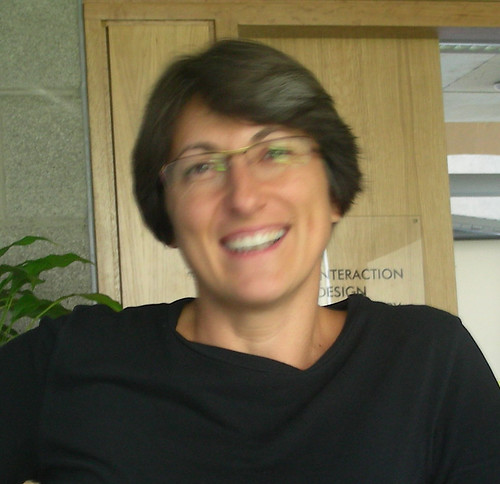
daniela

Daniela Petrelli from the University of Sheffield is visiting the IDC as part of the "Memoir" Project.
At Sheffield, Daniela teaches electronic publishing, digital multimedia and web-design.
Her current research interests are:
- information access, including multilingual (searching information in many languages) and multimedia (particularly historical archives of images and videos);
- information and knowledge management for sharing in manufacturing (Rolls Royce jet engine design, building and worldwide maintenance);
- personal digital memories.

Daniela moved to the UK in 2000 and previously I was a researcher at IRST in Trento, Italy where she did research on adaptive and mobile guides for museums, natural-language based interaction, intelligent interface interaction.
In a far past (1990-1993) she was at the Italian Telecon Research centre and worked on CSCW and teleconferencing systems mainly doing interface design and development.

The Memoir project will last for 4 years and is about the capturing, storage, organization, retrieval and sharing of multimedia personal memories. Personal memories are intended at large: email, documents (word, excel, powerpoint), messages on the phone, personal pictures, videos etc. Accessing means not today but in 10, 20 or more years time.
Several people are involved:
- 4 academics from the University of Sheffield (Daniela is one of those)
- 3 research associates (just recruited, 1 HCI, 1 Video/Image, 1 IR)
- 3 senior visiting fellows for 3 months on: ethics of memories, psychology of memories, social history.

Daniela's interest in the project is about sharing memories in a family context across different generations (children, parents, grandparents but siblings and cousins are welcome too ;-)
The goal is to design a something to facilitate the capturing composition and sharing of the memories across generations of tightly connected people.

Thursday, October 05, 2006

Thursday, September 28, 2006

MetaMusic (a.k.a. Abaltat) handover


For the past two years, a dedicated team of programmers and computer musicologists in the Interaction Design Centre in the Department of Computer Science and Information Systems at the University of Limerick have been working on developing a novel software package. The idea was to create software that automatically can compose music to video clips, such as television advertisements promos and documentaries, that would otherwise cost producers a lot in terms of music royalties.

The project's team-leader Mikael Fernström, the co-originator of the project and well-known computer-music composer, commented that “I’ve been working for so many years on finding new kinds of music by means of computing, but when the Abaltat team approached us as and asked if we could do popular music, we said Why Not!“

The resulting software prototype is now being transferred to an exciting new Irish start-up company, Meiticheol Teoranta, trading as Abaltat. Abaltat is located in Spiddal, Co. Galway. The development was sponsored by Enterprise Ireland’s Innovation Partnership programme. Abaltat is also supported by Údarás na Gaeilge, The Western Development Commission and Enterprise Equity Investment Fund.

At the recent IBC trade show in Amsterdam, Abaltat previewed AbaltatMuse. The software and was nominated for the prestigious IABM Peter Wayne Award. The product was also selected as pick of the show by Broadcast Engineering magazine and has been shortlisted by TVB Europe for their IBC awards to be announced in October

Mr Justin McCarthy, one of Ireland’s most well-known video editors and Technical Director of the company said "Based on our market research and the response at the international IBC trade show, we are confident that we have a worldwide success on our hands. The future of broadcasting includes the ability to deliver programming over all media including the web. The issue of music royalties is becoming more and more of a hinderance. Our software solves this problem giving editors an exciting and creative solution. Editors can now control how the music is written, using an editing interface.

The television world will never sound the same...

Special thanks to Eoin, Ian, Tony and Brian who have worked so hard, for so long, on delivering this vision. We'll do it again, next week ;-)

Thursday, September 21, 2006

Good Luck Steve!

After years of service, Stephen has left the IDC for greener pastures!
Here he is pictured at his going away party, already scared by what awaits him...
Good Luck Steve, and thanks for all your work with us!

Thursday, September 14, 2006

Interactive Media and Music Technology 2006

It's that happy time of the year. I-media and MusTechs are finalising their projects. We're all hoping that they'll do really well, and make us proud in the DAWN2006 show.

Monday, September 11, 2006

Limerick Milkmarket

So, our next design is Limerick Milkmarket. Why the hell am I writing this, it should be Parag! Anyhow, we've created an on-line cookbook.
We have spread some postcards to get people to send us their recipes. Hopefully we'll get some healthy suggestions.

Thursday, August 10, 2006

The Portal Experience


Here's the most relevant article written on the Portal in the past couple of weeks. It appeared in the Irish Independent.
Now that the Portal's exhibition is nearly over, a brief overview of people's interactions with it can be seen here.
The images "donated" by people to the Portal Gallery can be seen here.

Wednesday, July 19, 2006

The Portal Up and Running at Shannon Airport

The Portal is finally up and running in the transit lounge of Shannon Airport. A lot of interesting interactions around it and very positive feedback so far!

Thursday, July 06, 2006

Portal getting ready for Shannon Airport

So, this is it. On Tuesday, the contraptions we've built will move to Shannon. As the core team is now quite [too] small, we will probably ask all IDC:ers to help out at some stage.

Monday, June 26, 2006

ICAD2006

Last week, Cyberviking and Braz were at ICAD2006 in London. Apart from presenting our paper, this year's competitive activity was to sonify a number of concepts:

  • Communism

  • Red

  • Drama

  • Diversity

  • A Pint

  • A Dragon

  • C'mon England


The results of Group I can be heard here.

Friday, May 26, 2006

NomadS Seminar: Supporting Mobile Work: Approaches to designing technology

On Thursday, MAy 25th, the NomadS project hosted an open seminar: "Supporting Mobile Work: Approaches to designing technology". The seminar was aimed at discussing how the design of novel technological tools could improve the lives of "nomadic" workers. The seminar was sponsored by the NomadS through its funding bodies, Science Foundation Ireland and IRCSET. The seminar saw presentations of the work conducted on NomadS, and the participation of an invited speaker: Dr. Monika Buscher, University of Lancaster (UK).

Monika is an ethnomethodologist, ethnographer and designer interested in the study of people's practical action and the design of innovative technologies. She works with landscape architects, health professionals, patients, software designers, industrial designers, and sociologists, currently in a project called PalCom, which is part of the EU’s 6th Framework Programme.

Monika's talk was entitled "Extreme nomads: Mobility and embodied conduct in emergency teamwork".
Emergency situations demand fast, effective creation/preparation/maintenance of many different work places and connecting routes under often extremely chaotic conditions. It requires collaboration between diverse actors. Police, fire services, and medical personnel need to secure the scene, create access routes and ensure they are kept free, categorise, treat and transport victims, handle hazardous materials or deal with contamination, and coordinate work with emergency service personnel in emergency vehicles, dispatch centres, and hospitals. Communication is crucial, but often difficult under immense time pressure, in extremely complex and often dangerous settings. Embodied conduct plays a crucial role for communication and the coordination of mobility and the creation/preparation/maintenance of workplaces and routes. In this paper I discuss ethnographic observations from training exercises for major incidents and some prototypes for technological support for communication and coordination in emergency situations with a focus on the role of embodied conduct.

Thanks to all who participated!

Change

It's been a good day. Interesting seminar from Nomands project.
We all need to start to prepare [realise] that the IDC this autumn will be a different place, as almost half of the postgrads finish or bugger off. My ultimate fear is that I'll be the only techie left. I'll have nobody to talk to [or few].
Perhaps I should get a real job and develop Irish Homeland Security ;-)

Monday, April 03, 2006

Celeritas

This past week we had a hack-fest. Tyndall's latest motes with inertial measurement units were tested together with MAX/MSP for the purpose of creating the Celeritas composition.

Todd, Cian, Cindy, Andy

Steve, Giuseppe, Cindy

Wednesday, January 25, 2006

IDC Poll 25 January 2006: Movies and Celebrities

Looks like the IDC people are up there with A-B-C and D list celebrities, and have featured in a number of movies!

Appearances of IDC folks can be found in "Braveheart", "Michael Collins" (which also features Daniel's coat), and "a low-budget movie while Summering in the Hamptons in 1998". The wonderful walking skills of IDC people were also put to use in "walking past in the background" scenes in two German films (unknown titles) in Berlin 2000, and in a "people strolling down the street" scene for "Law & Order" in 2005.

Besides the silver screen and TV appearances, the world of theatre has been invaded by an IDC presence. Dr. Gabriela Avram recounts: " I had a part in a theater play when I was 6. I played about 30 times on a real stage (Timisoara National Theatre), with top class actors, in an excellent play. I was impersonating the daughter of a famous Romanian writer, and I was chosen not because I was cute or smart, but because I had the same name as hers!"

As for celebrity sightings, the juicy list includes: Madonna, Mel Gibson, Nicky from Westlife (met by Darragh at one of their concerts), Ian Dempsey, Alan Rickman, Bertie, Prince Albert (ask Tony), Thandie Newton (ER, "Crash", "Mission: Impossible II"), Jewel Staite (Kaylee from Firefly/Serenity), Faye Dunaway (Gabriela thinks it was her) Bill Gaver, Liam Bannon and Mikael Fernström (met by several IDC members in a number of occasions).

Monday, December 12, 2005

Wednesday, November 30, 2005

"Hedonic Computing" by Dr Barry Brown

Dr. Barry Brown of the Dept. of Computer Science, University of Glasgow has visited the IDC and has given a talk on Monday, November 28th on “Hedonic computing: the computer science of leisure and enjoyment”, followed by open discussion.
Abstract:
This talk explores the opportunities for a ‘hedonic computer science’. Within many parts of computer science there has been a subtle change in approach: from video conferencing to mobility, from flight simulators to video games, from artificial intelligence to A-life. These changes open opportunities for a computer science that is as concerned with enjoyment as much as it is with formalism.  I discuss how we might take leisure seriously as a goal within computer science.  In particular, I discuss three examples of playful technologies - a piece of RCA designed furniture known as the ‘drift table’, an online virtual environment called There, and a collaborative tourism system we have designed. These examples suggest how we might build systems differently to support activities such as wasting time, sociability and enjoyment.

Barry Brown, Equator Research Fellow, Dept. of Computing Science, Uni. of Glasgow

Tuesday, November 15, 2005

Survival and Demos

Over the past couple of weeks we did it all. The SFI review and then Science Day. Thanks to all brilliant IDC postgrads and staff, it worked. If any of our efforts will bring more resources and more science and technology graduates in the future, it was worth it.
Keep on hacking...

Wednesday, September 21, 2005

Some Shots from Mikael's surprise party


Thanks to Gabriela, we have these lovely shots taken last week at Mikael's surprise party for his 50th birthday. Happy Birthday again from all in the IDC as it wouldn't be the same without you.

Saturday, September 17, 2005

Fivezero experience

So this is it. It’s been a very intense day. The Amazing IDC really got me. I didn’t think it was possible to catch me off-hand like this, but they did. I was aware that there was The Mysterious Flash piece in progress (after walking into the lab and everybody standing around Ian’s desk pretending to whistle). The rest, I wasn’t prepared for.
As I had said before, my expectation was to keep on working and do the fivezero another day, so when the surprise happened, I found myself having very disparate feelings. The Working Man was very angry for getting his schedule wrecked, the Human Man was really wobbly, and in between those two my brain was trying to figure out what the hell to do. I guess I’ll live to see the photos.
I would just like to thank all the lunatics in the IDC asylum, the Masters students on the Insane Media course, and everybody else who made this day a – SURPRISE.
Still, I find it pleasing that I got to the IDC blog first ;-)

Friday, June 10, 2005

Bye Bye Microsoft Windows

After rebooting our exhibit in the City Gallery a few times, I have decided NEVER to use Microsoft Windows again for a public installation. Despite the fact that it's running on a fine little machine (Shuttle), and works fine on any Mac OSX, on Windows XP you get all kinds of trouble. In my case you're talking about a pretty normal multimedia file (Flash), about 230 Meg. EVen when everything seems to be running smooth, suddenly the evil Microsoft stuff pops up a dialogue that perhaps we need a Windows Update! No, no and no again.
So, from now on, if we're putting up machines in public installations, it should be Linux or OSX.
Goodbye Mr Gates. May you rot in reboot hell.

Wednesday, June 08, 2005

"Re-Thinking Technology in Museums"

Take a look at the programme for our IDC workshop "Re-thinking Technology in Museums". Really good papers and speakers from all over the world!

Sunday, May 01, 2005

Evaluating Roomba

I had the opportunity to borrow a Roomba – robotic vacuum cleaner – from one of my colleagues. For many years, I’ve believed that the touchstone test of robotics is if humans can make affordable machines that automatically can clean a house.
So, what’s the outcome?
In terms of smartness, the Roomba is fine. It’s really blind as its main sensorium seems to be by bumping in to things (touch). It was really amazing to see it drive in under a kitchen chair and developing eventually applying a suitable behaviour to get out of there again.
Did it clean our wall-to-wall carpets, removing both dust and dog hair?
No. It did the dust but didn’t manage the dog hair. Compared to my old Nilfisk industrial grade manual machine, the power of the fan in Roomba is just a fraction, hence it’s understandable that it can’t deal with this kind of situation. If we didn’t have carpeted floors, e.g. wooden floors, I guess it would have worked.
Verdict: Smart but lacking power.

Thursday, March 17, 2005

St Patrick's Day and many of us are NOT in a pub...

It's a strange year. I haven't had time or energy for months now to take a break, go to Guerin's and just live for a while. This St Patrick's Day several of us IDC:ers are busy writing research grant proposals, papers, budgets, etc. It's crazy! Why can't we just tell the world that if it wants our contribution, it'll have to wait a wee while.
Still, I guess I'm lucky. I've been out in the warm and dry weather several times today. My dog Charlie is really great at commenting on my writing when we're out walking.
- Should I cite XYZs paper do you think?
- whoof.
- OK, I'll leave it out.

Saturday, February 26, 2005

Sad day in interaction design

Jef Raskin, the author of "The humane interface - New directions for designing interactive systems", possible creator of the Mac, etc., passed away today. He was a good warrior, striving to remove clicks and key strokes, to enhance user experiences.
We'll all miss him.

Friday, February 18, 2005

Where is the new building?

We need to update the IDC web site so that visitors don't go to the wrong (and dreadful) place.
I took a couple of shots of the new building the other day:

Engineering research Building


Engineering research Building at night


Especially the evening shot shows clearly where the activity is at night ;-)

Tuesday, February 15, 2005

The move: We made it!

Finally, we're in. OK, there are many things still not working and we'll discover - day by day - that new circumstances will require new working procedures, but, overall I think it feels really good to finally have escaped teh CSIS building.

Monday, February 14, 2005

Moving times

So, finally it's time to actually move to the new building. We should keep track of:
1. How many boxes are lost.
2. How many computers they drop.
3. How long it'll take to get everything writed again.
Still, I'm looking forward to the whole thing. It'll be great not having to go to the CSIS building, unless it's a lecturing day. Over this weekend I've had so many positive vibes - All The Things We Can Build and Do - now that we'll be in a dedicated research space.

Thursday, February 10, 2005

The disappearing sink – Un-building a building

Today we discovered that they had removed the sink, water supply, etc., in our new premises. The whole worktop surface had been replaced, looking like there had never been a sink there! Last week when I checked, while it was still there, it worked fine! I suspect a major conspiracy here – somebody in Campbell Catering Ltd is messing with senior management at UL, to make sure that we cannot make our own coffee and tea (at cost price), to ensure continued extortion of both faculty and students in their over-priced and bad and low quality cafes and restaurants.
I suggest a total boycott on Campbell catering, until we get things the way we want them!

Friday, January 28, 2005

Have you stopped typing?

What's happened to our, normally, dynamic group? I've checked your personal blogs (no action) and this one has gone stale. We should be trashing out current issues here!
- The move to new building.
- New curricula
- Will you get paid next month
- Writing new exciting proposals
- Finding new truths
As I'm kind of off-campus a lot, I look at IDC web activities and see, very little. What's happening?

Monday, November 15, 2004

A toast to Tony's success

Long-term IDC member Tony Hall successfully defended his thesis today and was awarded the PhD!
Tony's thesis is entitled "Disappearing technology, emerging interactivity: A study of the design of novel computing to enhance children's learning experience in museums", and deals with the application of a framework inspired by Interaction Design practice to the development of educational museum exhibitions.
Tony's external examiner was Dr Lydia Plowman from Stirling University. Dr Eamonn McQuade was the internal examiner.
Congratulations to Dr. Tony Hall on his success!

Friday, November 05, 2004

Irish Electric Showers

This is really a mystery of lack of design and usability. I’ve just encountered a newly installed Centon Generation M888EP Multipoint Step Control device. It has a built-in pump to provide enough pressure to make you believe that you’re not standing outdoors on a soft day. But its thermal control just sucks. It has three settings: Low, Medium and High. In terms of water temperature, these settings result in Freezing, Cold and Scalding. This leaves you, as a user, with only a few options. You can either keep switching between Scalding and Cold, or, you set the dial to Scalding and try to put the showerhead really high and then you kneel down, hoping that the air will cool the boiling water on its way down. Alternatively, you can set the dial to cold and just suffer and shiver. Perhaps the design of Irish Electric Showers is a scheme devised by the Catholic Church. When modern times arrived and fewer people went to Mass, the Electric Shower was devised to make people realise what Hell might be like – in a very physical sense.
When will somebody teach Irish designers about continuous control and things like triacs, pulse-width modulation, control using feedback, etc…? With a small bundle of electronics, for less than 10 euro, you could easily provide constant and continuously controlled temperature of the water.

Monday, October 18, 2004

Forthcoming IDC seminar

IDC Research Seminar
Friday, November 12, at 2.00PM

Venue to be confirmed.


Programme
2.00-2.30 Ian O'Keeffe
"A Video-Driven Soundtrack Composition System Utilizing Video Stream Event Detection And Automated Music Generation"
Current soundtrack composition practice relies either on the use of a contracted composer to write from scratch or the use of music excerpt libraries to select the type of music required, with related costs linked with such an approach, royalties and musicians rights issues (IMRO). It is proposed that a new approach be taken for the generation of such incidental music, by composing or generating suitable music, probably driven by a 'wizard'-style interface or prompting method, which would be influenced by the content of the selected video stream with regard to rate of change, shot rate, and so on. After further investigation it has transpired that the alternative of applying more direct control over the marking of events would also be desirable, as would the facility to input EDL (Edit Decision List) files, these being a de-facto standard across the video industry. A number of approaches for the music generation are being investigated, the heuristic and statistical techniques being most prevalent.


2.30-3.00 Darragh Murphy
"Use of Biometrics as a database security measure" Goal of this project was to investigate the use of fingerprint recognition as a suitable
biometric measure for an authorized secured access to a database. The project entailed research into methods of fingerprint recognition and how it
has been developed and improved since its conception. While on co-operative education, Darragh was involved in Web Development and
maintenance, Developing online surveys, Software testing, Online services evaluation and he orchestrated the organizations computer auditing project.


3.00-3.30 Iride Bartolucci
"Interactive Playgrounds: how to stimulate the physical activity of children through playing, using new technologies"
Iride's role on the project was to formulate activity scenarios, with the aim to try and define necessary requirements for the implementation
of a novel playground. In particular, Iride designed a game to be implemented on the tiles-platform, that had the goal to develop the physical and cognitive
activity of children. Iride tested the game with children and also videotaped the activity to analyse the video through an ad hoc
observation grid she developed. The video-analysis activity was important to find new requirements about the prototype and to have significant data
about the physical performance and the cognitive activity of children and also about the design of the artefact.


3.30-4.30 Tony Hall
"Disappearing technology, emerging interactivity: A study of the design of novel computing to enhance children's learning experience in museums"
Museums are key sites of children's learning. However, they increasingly face competition for children's attention from other edutainment
activities and centres. In order to make their museums more appealing to children, curators and museum designers and educators are installing
computers in their galleries and exhibition spaces. However, the way in which this technology has been deployed in museums has often proven
problematic, serving to detract from, rather than enhance the interpretive experience of children. This has largely been the result of the inherent
limitations of standard computing. However, can novel computing (pervasive and ubiquitous computing), with
its potential to transcend problematic constraints of the desktop PC, be designed to enhance children's learning experience in museums? This is
the question that this thesis explores through development and evaluation of an innovative computer-supported exhibition, which was
designed to enhance children's museum learning. Emerging from the analysis of children's experience of the exhibition, the thesis firstly
proves that there are new interactive possibilities with novel computing to enhance the educational potential of museums. The thesis also
produces design guidelines, which identify the criteria of an effective computer-augmented museum educational experience for children. These
guidelines furthermore clarify the design informants and resources, which need to be consulted in order to effectively create such an
experience.